My dad talks about his enlistment, basic training, and how he went from horse buyer to the First Cavalry in WWII.
Wednesday, August 27, 2008


Saturday, August 23, 2008
Watch your language
When I first became aware of the Typo Eradication Advancement League, it warmed this English teacher's heart. Now it seems that even the war on inexact language is getting dangerous.
I'm not prudish about a lot of the errors I see, but sometimes I get a kick out of the many typos that jump out at me. Here's a photo from a realtor's listing in Red Lodge, Montana.
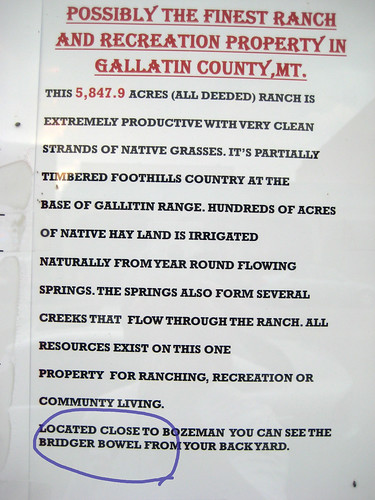
It may be the finest ranch in the county, but I'm not sure I'd like that view.
WAVY-TV reported that the brains behind the operation -- Jeff Deck of Somerville, Massachusetts, and his cohort Benjamin Herson of Virginia Beach -- admitted to their conspiracy and complicity to deface a historic marker because it contained a typographical error. Restitution and probation were ordered, and in addition the dynamic duo of grammarians with a purpose is banned for one year from national parks.
Typo Eradication Advancement League Stamped Out? - Associated Content
It may be the finest ranch in the county, but I'm not sure I'd like that view.
Saturday, August 16, 2008
Stevie Nicks went to my school?

The world came to know Nicks as the whirling songstress whose dramatic lyrics about a Welsh witch named "Rhiannon" helped bring her to the eye of the hurricane that became Fleetwood Mac in the 1970s. Her Utah friends say that her icon status and stage antics can be directly traced to the one month she spent studying at Salt Lake City's Judge Memorial Catholic High School. For the record, Nicks attended eighth and ninth grades at Wasatch Junior High before a bad math grade prompted her parents to send her to Judge. "Because she had gone to a private school, we would get together after school and talk about our different classes," said Karen Thornhill, who remembers Nicks when she went by Stephanie Lynn Nicks and twirled the baton at junior-high football games. "I distinctly remember her waving these capes around, imitating the nuns who taught her classes."
Wednesday, August 06, 2008
Peace in the goodness of time
 Tonight was one of those nights when being a teacher is so rewarding.
Ross Chambless, a former student of mine, has put together an impressive traveling exhibit called "Ceremonies, A Tale of Sister Cities: Matsumoto and Salt Lake." Ross just finished teaching English in Japan for four years in Matsumoto, Salt Lake's sister city. In his spare time he did some work for NPR and started collecting oral histories from the citizens of Matsumoto, which is detailed on his Ceremonies Exhibit blog. Those histories became the basis of the traveling exhibit done in conjunction with the Center for Documentary Arts that's at the Salt Lake City downtown library until August 8. (Photo courtesy of Ross Chambless, http://tinyurl.com/55omyd)
August 6 is the anniversary of the atom bomb being dropped on Hiroshima. Takashi Hiraoka, mayor of Hiroshima from 1991-1999 addressed a rapt audience at a commemoration at the Salt Lake library this evening. I'm reading John Hersey's Hiroshima with my seniors and now see the event from yet another perspective. And as Mr. Hiraoka spoke, I thought of Roy Okamoto, a former custodian at our school, who lost everything when he was sent to the internment camps in Topaz, Utah. We've come a long way in our relations with the Japanese people. As I later listened to the Amarume Japanese boys and girls choir, I couldn't help thinking of another international peace project that I've been involved with for years, The Ulster Project.

As I finished my conversation with Ross, I was filled with hope about our world. Ross feels like the Sister Cities program helped diminish stereotypes Utahns had about Japanese people; and I feel like things are improving in Northern Ireland because of programs like the Ulster Project. Here's hoping more educational exchanges like these continue.
Finally, a lasting impression from the evening was the legacy of Dwight D. Eisenhower, who I've come to respect even more after I watched Why We Fight. He started the Sister Cities International Program, and his granddaughter, Mary Jean Eisenhower, incidentally is following in his footsteps as president of People to People International. I now think of Eisenhower as one of our greatest presidents. A seasoned military man, here was the tone of his last days in the Oval Office.
Before he left office in January 1961, for his farm in Gettysburg, he urged the necessity of maintaining an adequate military strength, but cautioned that vast, long-continued military expenditures could breed potential dangers to our way of life. He concluded with a prayer for peace "in the goodness of time."
Wednesday, July 09, 2008
Visualizing presentations
I'm trying to pay more attention to design these days, both in my personal life and in my teaching/learning.

And when it comes to information designa recent infographic from XPLANE does a nice job of graphically representing the complex idea of how Obama has reinvented campaign finance by leveraging the power of online social networks. And this post by Ewan McIntosh is one of the best explanations of what makes for a good presentation.
Another quote I like: "PowerPoint doesn't kill presentations, bullet points do."
And when it comes to information designa recent infographic from XPLANE does a nice job of graphically representing the complex idea of how Obama has reinvented campaign finance by leveraging the power of online social networks. And this post by Ewan McIntosh is one of the best explanations of what makes for a good presentation.
When we experience a presentation we experience it in two ways - through the auditory nerves (ears) and the optical nerves (eyes). The brain is geared up to seeing above all else: 30% of the cortex is devoted to visual processing, only 8% for touch and 3% for hearing. So, biology tells us that our presentations must be, above all, visual.
Another quote I like: "PowerPoint doesn't kill presentations, bullet points do."
Wednesday, June 25, 2008
Is the Internet making us stupid?
In the latest issue of the Atlantic, Nicholas Carr writes a thought-provoking piece about how the Internet may be changing the very way we think.
As a teacher who incorporates a number of Web 2.0 tools, the article gives me pause. Since I also taught a couple of decades without the Internet in my classroom, however, some of what he writes seems a bit too simplistic. My classes start with 10-15 minutes of sustained reading (of books) or writing (in journals); there is a collective calm that ensues as the students and I engage in what one of Carr's sources might call "rich mental connections" with traditional texts and tools. Sometimes that involves writing on paper what we've been learning from online sources.

To use Carr's own metaphor, isn't it possible to be a person who enjoys both jet skiing and scuba diving? Just because I now jet ski, does that mean I can no longer scuba dive? That's silly. What this all means to me as an educator is that I've got to be more explicit in my teaching about the "rules" that govern reading and writing in traditional vs. digital composition. We don't need to unplug (as he seems to imply), rather we need to become fluent in the various media.
As the media theorist Marshall McLuhan pointed out in the 1960s, media are not just passive channels of information. They supply the stuff of thought, but they also shape the process of thought. And what the Net seems to be doing is chipping away my capacity for concentration and contemplation. My mind now expects to take in information the way the Net distributes it: in a swiftly moving stream of particles. Once I was a scuba diver in the sea of words. Now I zip along the surface like a guy on a Jet Ski.
To use Carr's own metaphor, isn't it possible to be a person who enjoys both jet skiing and scuba diving? Just because I now jet ski, does that mean I can no longer scuba dive? That's silly. What this all means to me as an educator is that I've got to be more explicit in my teaching about the "rules" that govern reading and writing in traditional vs. digital composition. We don't need to unplug (as he seems to imply), rather we need to become fluent in the various media.
Tuesday, June 17, 2008
ScribeFire tests
I'm always on the lookout for the easiest way to publish online, especially in my classroom. I've been using Flock because of the web snippet/clipboard capability. Now that Firefox has added the ScribeFire extension, I've been testing it.
I can't get the "Add an image" button to integrate with my Picasa gallery very easily.

I had to drag and drop the embed code into the source editing panel; when I pasted the code of this picture I took into the "Add an Image" popup window, I just got an unattractive little box like this one
It doesn't automatically format text that I pull from a source like Flock does, I had to manually make a block quote:
And I could only get out of the block quote formatting by going to the source editing tab, not from the rich editing tab that most users would prefer using. Maybe I'm missing something, but ScribeFire needs a lot of work if I'm going to bring it into my classroom (or into my own online publishing habits).
I can't get the "Add an image" button to integrate with my Picasa gallery very easily.
I had to drag and drop the embed code into the source editing panel; when I pasted the code of this picture I took into the "Add an Image" popup window, I just got an unattractive little box like this one
It doesn't automatically format text that I pull from a source like Flock does, I had to manually make a block quote:
you can drag and drop formatted text from pages you are browsing, take notes, and post to your blog.
And I could only get out of the block quote formatting by going to the source editing tab, not from the rich editing tab that most users would prefer using. Maybe I'm missing something, but ScribeFire needs a lot of work if I'm going to bring it into my classroom (or into my own online publishing habits).
Wednesday, May 28, 2008
Online offerings
The administration at my school is thinking about the future of our online offerings. I came across this today.
Obviously online course content delivery is coming soon, but "half" of all courses by 2019? Part of me says that's actually low. I think more than half will be offered a lot sooner.
Enrollment in online classes last year reached the 1 million mark, growing 22 times the level seen in 2000, according to the North American Council for Online Learning. That's just the start, says a new paper by the Hoover Institute, a conservative think tank at Stanford University. Its authors predict that by 2019 half of courses in Grades 9 to 12 will be delivered online. The efficiency of online learning accounts for this growth. But there's little research assessing the quality of these programs, which some experts say don't have enough official oversight.
Virtual schools see strong growth, calls for more oversight | csmonitor.com
Obviously online course content delivery is coming soon, but "half" of all courses by 2019? Part of me says that's actually low. I think more than half will be offered a lot sooner.
Tuesday, May 27, 2008
Living Archives
I've been following the development of the Living Archives Project because it's an authentic way to teach writing and because for years my students have been doing some local ethnography as well. The blend of traditional and Web 2.0 tools that Dave Cormier and the rest of the people on Price Edward Island are using is impressive. So as teachers start to wind down this school year and begin to think about the next academic year, this is an inspirational place to start.
View Larger Map
View Larger Map
Sunday, March 30, 2008
Earth Hour and Climate Savers

Did you miss yesterday's Earth Hour?
On Saturday, March 29, 2008, Earth Hour invites people around the world to turn off their lights for one hour – from 8:00pm to 9:00pm in their local time zone.
Climate Savers, mentioned in the Google news release, is advocating some painless, attainable ways to save energy.
The fight against global warming starts with you! Did you know that the average PC wastes nearly half the energy it consumes?
Saturday, March 29, 2008
Story crisis
Steve Jobs talks about a "story crisis," which should be refreshing for all writers. Sometimes we come across a really well written story and never think about the roadblocks that the story tellers encountered and what they did to overcome the 'crisis.' It's about being honest with yourself and listening to your heart.
"At Pixar when we were making Toy Story, there came a time when we were forced to admit that the story wasn't great. It just wasn't great. We stopped production for five months.... We paid them all to twiddle their thumbs while the team perfected the story into what became Toy Story. And if they hadn't had the courage to stop, there would have never been a Toy Story the way it is, and there probably would have never been a Pixar. "We called that the 'story crisis,' and we never expected to have another one. But you know what? There's been one on every film ... there always seems to come a moment where it's just not working, and it's so easy to fool yourself - to convince yourself that it is when you know in your heart that it isn't.
Steve Jobs speaks out - On dealing with roadblocks (10) - FORTUNE
Tuesday, March 11, 2008
More Brit kids prefer reading over TV
 The Independent reports that fewer British 11-year-olds prefer watching TV over reading. A telling sentence in the story:
The report, published to coincide with World Book Day, concludes there can be "cautious optimism" over the survey's findings and says that government encouragement of more flexibility and creativity in the curriculum could have helped foster more of a love of reading.Children turn off the TV and open a book instead - Education News, Education - Independent.co.uk
It would be interesting to see how the attitude of American children toward reading has changed over the same time period. Are we fostering a love of reading as a society?
Photo by Judge photog

Wednesday, March 05, 2008
Smart students
I came across this article about how smart Finnish teenagers are, based on a test adminstered by the OECD. Of course the causes are complex, but a couple of ideas struck me.
Another key idea comes out when a Finn student discusses her foreign exchange experience in an American school: "The rare essay question, she says, allowed very little space in which to write." The article doesn't oversimplify the differences in the two nation's education system, but I still couldn't help but notice that a curriculum that fosters reading and writing produces successful results.
Finnish teenagers are among the smartest in the world. They earned some of the top scores by 15-year-old students who were tested in 57 countries. American teens finished among the world's C students even as U.S. educators piled on more homework, standards and rules.
What Makes Finnish Kids So Smart? - WSJ.com
The article interested me for a number of reasons, one of which is the fact that the English Department at my school is currently having discussions about what students should read next year. This part of the article speaks volumes about the Finnish students' success:Finnish teachers pick books and customize lessons as they shape students to national standards. "In most countries, education feels like a car factory. In Finland, the teachers are the entrepreneurs," says Mr. Schleicher, of the Paris-based OECD, which began the international student test in 2000. One explanation for the Finns' success is their love of reading.
What Makes Finnish Kids So Smart? - WSJ.com
Another key idea comes out when a Finn student discusses her foreign exchange experience in an American school: "The rare essay question, she says, allowed very little space in which to write." The article doesn't oversimplify the differences in the two nation's education system, but I still couldn't help but notice that a curriculum that fosters reading and writing produces successful results.
Sunday, February 24, 2008
Aritstotle and authenticity

A lot of the teachers I’ve been listening to lately have been distraught over plagiarism in their students’ writing. I try to sympathize, but I can’t relate. I’m not having those issues. When writing begins with inquiry, makes connections to the self’s place in the world, and sourcing is transparent, there doesn’t seem to be much of a problem.
At the same time I’ve been reading about Aristotle’s rhetorical triangle – the connections and interdependence of speaker, audience, subject; the appeals to logos, ethos, pathos; and the added elements of context and purpose. When we compose from that framework, plagiarism is an awfully alien concept.
Painting by Raffaello Sanzio from Wikimedia Commons and is a public domain image

Thursday, February 14, 2008
Heart candy & literacy
Has anyone else noticed that heart candy just ain't what it used to be. While I was crunching on my Necco Sweathearts that my valentine gave to me this morning, I was a little puzzled by some of the messages on the candy, so I just had to snap a couple of photos as evidence. Since when is "and" an appropriate message to put on a candy heart?

And what does this say, "Lap Dog"? Does Necco need more proofreaders?

At any rate, one of my enduring memories of Valentine's Day present and past is opening up a box from my valentine and seeing a candy like the one below.

And what does this say, "Lap Dog"? Does Necco need more proofreaders?
At any rate, one of my enduring memories of Valentine's Day present and past is opening up a box from my valentine and seeing a candy like the one below.
Monday, January 21, 2008
Seeing Through

This last week my students wrote an essay taking a position on whether television has had a positive effect on presidential elections. I came across this post by Roy Peter Clark from the Poynter Institute that speaks to this well. In it he cites Edward R. Murrow, Aldous Huxley, and Thomas Jefferson among others. It's amazing how timely these thoughts are as we are bombarded with stories about image and our current presidential candidates:
Here's Murrow: "A society of the wise does not need television. Democracy, I suggest, cannot do its work well without it. Supposing that freedom is more important than safety, then the tyranny of the wise is only less objectionable than the tyranny of the unwise. The choice we face is between a despotism of the ruthlessly ambitious, not of the wise, and of an intelligent democracy." In other words, citizens need to develop a form of critical literacy that allows them to encounter the political words and images on the television screen and not just see them, but see through them.
Poynter Online - Writing Tools
It's not television, per se, that's the problem. It's what we do with it ... or rather what we don't do with it, that we won't often take the time to be critical consumers. That's the same for technology in general. I'm trying not to be skeptical, but it looks as if tomorrow's Frontline (Growing Up Online) might be another doom and gloom look at new media tools. Hopefully there will be a range of opinions.As in so many things, education is the answer.
Original image from "Wikimedia Commons" of Edward R. Murrow
Thursday, January 03, 2008
Good Educational Blogging
Here's my take on what educational blogging can be, with examples from youthvoices.net
Monday, December 31, 2007
Bigger and Better?
Although there are some obvious exceptions, bigger doesn't always mean better.
The more I work with computers in the classroom and incorporate technology in my own life, the more I get concerned about my own consumption habits but also about our consumption as a society. Consider the trend toward bigger TV's:
After watching cars get bulkier up to the gas shortages and oil embargo of the 1970's, and then witnessing our collective amnesia as we again bought larger and larger personal vehicles, culminating in the tank-like Hummer, I'm concerned with the proliferation of computers that require more energy. As a teacher I'm pretty sure that there will be more computers in classrooms next year than there were last year. And I don't see that trend changing. But what are institutions and businesses doing about this increase in comsumption. Is there much talk of conservation where you work?
Kudos to Tufts University in the late-1990's for at least trying to address the issue as an institution:
Tufts has made it a point to raise awareness of their institutional energy consumption. There should be more of that happening, even from an economic standpoint, let alone an enviornmental one.
So one thing on my list of New Year's resolutions is to become more aware on a personal level about Energy Star ratings and the data behind them, on a professional level as a classroom teacher to think more about when and how to best use the computers available (and when to shut them off), and to raise awareness of my school's consumption habits as a whole.
The more I work with computers in the classroom and incorporate technology in my own life, the more I get concerned about my own consumption habits but also about our consumption as a society. Consider the trend toward bigger TV's:
According the National Research Defense Council as told to The Christian Science Monitor, by 2009, when half of all new TV sales are expected to be extended- or high-definition digital sets with big screens, TV energy use will reach about 70 billion kilowatt-hours per year nationwide—about 50 percent higher than at present.
Big TV = Big Electric Bill : Robin Raskin : Yahoo! Tech
After watching cars get bulkier up to the gas shortages and oil embargo of the 1970's, and then witnessing our collective amnesia as we again bought larger and larger personal vehicles, culminating in the tank-like Hummer, I'm concerned with the proliferation of computers that require more energy. As a teacher I'm pretty sure that there will be more computers in classrooms next year than there were last year. And I don't see that trend changing. But what are institutions and businesses doing about this increase in comsumption. Is there much talk of conservation where you work?
Kudos to Tufts University in the late-1990's for at least trying to address the issue as an institution:
The average desktop computer uses about 120 Watts (the monitor uses 75 Watts, and the CPU uses 45 Watts.) Laptops use considerably less, around 30 Watts total. 4,300 Tufts-owned computers X 0.12 kW X 250 workdays X 8 hours = The university uses 1,032,000 kWh per year to run all of Tufts computers just during business hours.
This amounts to: 1,032,000 kWh X 11 cents = $113,500 per year in electricity costs. Greenhouse gas emissions for this electricity amount to: 1,032,000 kWh X 1.45 lbs of CO2 per kWh / 2,000 = 748 tons of CO2 per year. 100,000 - 500,000 trees are needed to offset these yearly emissions of CO2! (A tree absorbs between 3-15 lbs of CO2 per year.)
Tufts has made it a point to raise awareness of their institutional energy consumption. There should be more of that happening, even from an economic standpoint, let alone an enviornmental one.
So one thing on my list of New Year's resolutions is to become more aware on a personal level about Energy Star ratings and the data behind them, on a professional level as a classroom teacher to think more about when and how to best use the computers available (and when to shut them off), and to raise awareness of my school's consumption habits as a whole.
Tuesday, November 13, 2007
NCTE 2007

I'm doing a session at the National Council of Teachers of English in New York City on Sunday, 11/18. Here's a link to the presentation slides. and another link to additional resources mentioned at the presentation.
Since 1911, NCTE has worked to advance teaching, research, and student achievement in English language arts at all scholastic levels.
Thursday, October 25, 2007
notebooks & blogs, part 1

I'm not in a one-to-one computer classroom, so my students don't always have access to Web 2.0 tools. This quarter I've had my students do both the traditional writer's notebook (pen on paper) and blogging when we can. As I have them write their reflections on the two different media, I'm interested in what kind of differences they see. My commentary can be heard by clicking "writer's notebook reflections" on the audio player on the lefthand side of this page or on my GCast channel. Photo by Rosalie Sloan.
Subscribe to:
Posts (Atom)