Showing posts with label NWP. Show all posts

Saturday, August 16, 2014

The glory of unfinished learning

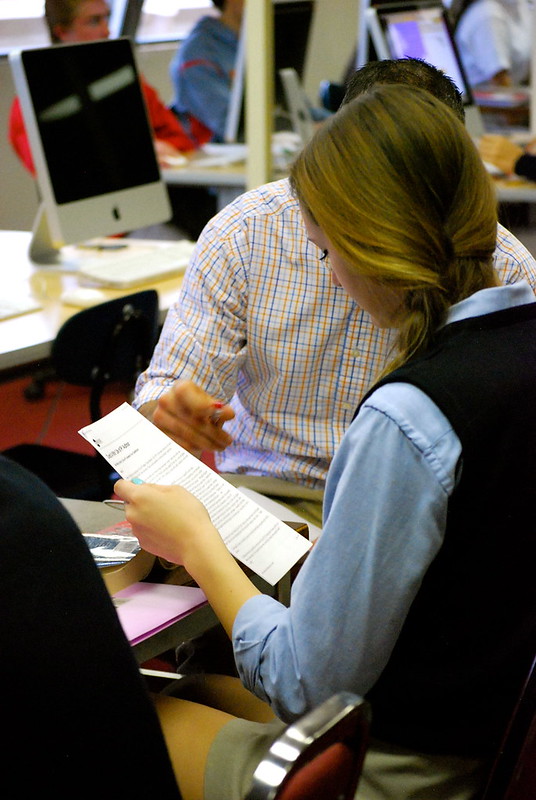
Photo by Sarah Beth Anderson
If you're a writing teacher, you've probably encountered the following situation: a colleague from another discipline waves a student paper at you and complains "these kids can't write." It happens to me at least once a year.

In the past I've told these colleagues that maybe the assignment wasn't clear enough or that perhaps they should treat this as a draft, as another step in the writing process, that surface errors are most likely related to performance – not competence. But a lot of times content area teachers don't plan on doing multiple drafts of a paper, and I sense that they walk away from our conversation even more convinced that student writing skills are on a gradual decline.

But I just came across a book that sheds more light on this. According to Lee Ann Carroll in Rehearsing New Roles: How College Students Develop as Writers, research shows that student writing appears to be weaker when they encounter new and unfamiliar expectations. Student writing develops because they must take on new and difficult roles in a discipline that they've probably never encountered before. It's reasonable to assume that students' new learning is creating all the cognitive load and that their early writing reflects this.

This all reminded me of the 1972 Donald Murray essay, "Teach Writing as a Process, Not Product." In the essay, Murray notes that since most English teachers were trained to analyze a product like a sonnet by Shakespeare and that they focus their critical attention on student writing as if it were a product. According to Murray, the problem with that approach is that a teacher's "attack does little more than confirm the student's lack of self-respect for their work and for themselves." Murray instead argues that teachers should "glory in the unfinishedness"of student writing.

So now when a colleague approaches me with the complaint that writing teachers like me aren't doing enough to prevent the next generation's slow slide into illiteracy, I've got another answer. Content area teachers might anticipate initially weaker writing as students deal with new concepts in unfamiliar disciplines – that's a sign that they're learning.

Then I'll advise them to make sure their assignments are clear and to build in some time for revision.

Monday, March 11, 2013

Teaching curation in the classroom

Cowboy by me
My media students have been using some KQED Lowdown resources lately to try to understand the gun control debate. As my students and I have studied this issue for the past few weeks, a couple of things have occurred to me. My first observation is how complex many issues are today. It can be difficult for students to write a simple thing like a piece of argumentative writing, or participate in a classroom debate, when there's so much information on the topic. Trying to get a handle on an multifaceted issue can be overwhelming for all of us. This leads me to my second observation – researching wicked problems like gun violence in America might be better undertaken in collaborative groups not only in classrooms but also in larger connected learning environments.

Here's how it went in my class.

Currently KQED has seven resources under the gun violence topic. I started off by dividing students into seven groups and had them examine one of the resources. Individual students first wrote a summary of their article's main points. Next they shared their summaries with their group members. In the end the group was responsible for one summary that best represents the ideas of the group and then presented to the rest of the class. Here's an example summary from one of the groups in my class.

To make doing these activities more manageable, I've always appreciated objective educational resources that have been assembled by experts, for example EBSCO Host Connection gun control resources and ProCon's concealed gun fact sheet. These are packaged to make researching more efficient for students and teachers, but I've also begun to realize that the act of searching for articles and discussing the merits of sources is an integral part of learning how to thrive in a knowledge economy. That's why I'm doing more collaborative research projects in my classes now on sites like Diigo, Delicious, and Gooru. One project that gets at what I'm moving toward is this shared Gooru collection that has been added to by Paul Allison's students in New York City and my students in Utah.

I've found that the most effective groups consist of informed individuals. Once we go through the process of collaboration and curation, we're much better able to articulate a stance on complex issues.