Showing posts with label annotation. Show all posts

Thursday, July 25, 2019

Two online annotation tools - NowComment and Hypothes.is

Conversation via annotations in NowComment
In the book Words Onscreen, author Naomi Baron cites research that might surprise you: When it comes to reading for school, today’s students prefer reading on paper over reading onscreen. According to Baron, our students may compose copious amounts of digital writing on their personal devices, but when it comes to close reading, students still prefer printing a PDF and annotating it with a pencil in hand.

Baron cites a study from late 2013 whose findings show that 84% of U.S. college students say they prefer print over digital text because it’s easier to bookmark and highlight. Baron readily admits this may change with time: “Annotation becomes easier on digital devices, especially for those who practice” (p. 30).

There’s no doubt that our students will get a lot more practice annotating online. In fact, annotating the Web is nothing new. The developers of Mosaic, one of the earliest browsers from the ’90s, envisioned a Web that anyone could annotate. And there’s no shortage of web annotation tools—Bounce, Diigo, and Genius, to name a few.
Hypothes.is screenshot

But over the past couple of years the two annotation tools that I've used most in my teaching areNowComment and Hypothes.is.

I use NowComment most frequently now. Here's an article I wrote that discusses NowComment's affordances and constraints.

And here's another article I wrote about Hypothes.is.

Thursday, January 31, 2013

Annotation and reading comprehension

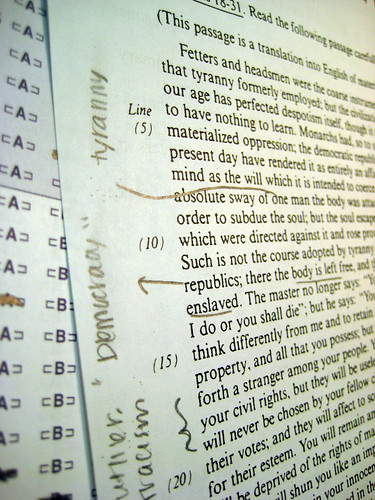
It might not mean much, but as I was recording some scores in my gradebook today, I noticed the difference between my students who annotated versus those who didn't annotate a sample AP English Language multiple choice passage. Out of the 65 students who took the test, 33 of them annotated but 32 didn't. The people who annotated the passage scored on average 9% higher than the students who didn't. I always encourage the students to read with a pencil in hand, but it's not a requirement; now I'm rethinking that. The image on the right is of a student of mine who had a perfect score, and I couldn't help but notice the rich annotation on the passage (arrows, summary, brackets, quoted materials). I haven't had the time yet to do more than a cursory view of the research on the effect of annotation on reading comprehension, so this could just be a coincidence.

And even if it isn't an isolated phenomenon, we all know that correlation isn't causation. Maybe annotation makes more effective readers, or maybe more effective readers annotate. Still, it does make me wonder....