My seniors last day of school was Friday. One of the last things I had them do was to share the secrets of their craft, another time when the students become teachers. Their videos showcase their excellent work, but also show how articulate they are. Check out their work:
Tuesday, May 22, 2012


Tuesday, March 27, 2012
Students as teachers, part one
 |
| Photo by Ben Harvey |
Some of the things they'll teach:
Sports action - Alex, Jeannie
Tyler - how to light and shoot studio portraits
Sylvia - environmental portraits
Ben - long exposure
Photo apps - (Abby & Zoe)
Christina - wildlife
Josh - perspective
Pets - Rachel, Shea
Danny - landscape
Kyra - gourmet macros
Tuesday, March 20, 2012
Integrity and disconnectedness
Yesterday, I wrote about an emerging challenge in my teaching, the overwhelmed feeling students get when they experience information overload. The curriculum's already crowded, so I'm wondering where this fits in my teaching. What's a composition teacher to do? Some answers have come from the Future of the Internet V survey conducted by Pew Research and Elon University.
Here are some excerpts from a recent Mind/Shift article "Doomed or Lucky: Predicting the Future of the Internet Generation."
Here are some excerpts from a recent Mind/Shift article "Doomed or Lucky: Predicting the Future of the Internet Generation."
Barry Chudakov, a Florida-based consultant and a research fellow in the McLuhan Program in Culture and Technology at the University of Toronto: “The cognitive challenge children and youth will face (as we are beginning to face now) is integrity, the state of being whole and undivided. There will be a premium on the skill of maintaining presence, of mindfulness, of awareness in the face of persistent and pervasive tool extensions and incursions into our lives. Is this my intention, or is the tool inciting me to feel and think this way? That question, more than multitasking or brain atrophy due to accessing collective intelligence via the internet, will be the challenge of the future.” Alvaro Retana, a technologist with Hewlett-Packard. “The people who will strive and lead the charge will be the ones able to disconnect themselves to focus on specific problems.”A musician friend of mine says that the pause is as important the note, and I've learned that white space is a powerful design element. Maybe the same is true of digital writing. To be a valued part of a interconnected learning community is to know when to be whole, undivided, and disconnected."
Monday, March 19, 2012
Infofatigue and impatience
 |
| Link to original |
My students and I were discussing Martha Irvine's 3/15/12 article (based on Twenge's research) which claims that today's teens are less environmentally conscious and less civic-minded than previous generations. At first I was surprised when my students readily agreed with the article's premise because I consider them to be pretty enlightened in those two areas. But they were quick to agree with Irvine. "We're not as green as our parents," one student said without batting an eye. She then said she'd read somewhere that recycling plastic water bottles is more costly than producing new ones and saw recycling as "a waste" (a waste of effort, by the way, not of resources); after some competing claims were tossed about, the subject shifted. On the topic of civic-mindedness a student brought up the Kony 2012 video citing stories that said that Invisible Children give less than 30% of the money they raise to African sources; another student said that was false, based on what she'd read on the nonprofit group's financial statements on their website. But pretty soon it went the course that too many contested discussions go – to a stalemate. As their teacher, this gave me pause. We had two fascinating discussions, but without a resolution to either. It reminds me of what Shin has found – we don't want to wait for the answer, and so we move on, without a resolution ... and, I suspect, with a gnawing dissatisfaction.
It's easy to become inundated with facts to the point of information fatigue. As Irvine wrote:
... are they just overwhelmed? Mark Potosnak, an environmental science professor at DePaul University in Chicago, has noticed an increase in skepticism - or confusion - about climate change among his students as the national debate has heightened. That leads to fatigue, he said. "It's not so much that they don't think it's important. They're just worn out," Potosnak said. "It's like poverty in a foreign country. You see the picture so many times, you become inured to it."
I can't help but think about the Stanford Marshmallow Experiment and follow-up studies which indicated that children in the original study who exhibited delayed gratification were later described by their parents as being more competent adolescents and found to be more academically successful. It left me wondering if I should be even more explicit with my students on how to take a more measured, deliberate approach to a medium teeming with actionable content and instant gratification ... and if so, how?
Friday, March 09, 2012
Blogging the research paper
Open Education Week, Day 5
 One of the staples of the language arts classroom is the Research Paper. I wrote them when I was in high school, I still assign them as a secondary teacher, and when standardized testing permits, a lot of other teachers still assign them today. Even in my pre-Internet classroom, though, I struggled with the end result. I mean, after the research has been drafted, workshopped, revised, polished, and the paper graded, what becomes of it? For the most part the scholarly research ended there. Never really got much farther than that myself.
But lately I have to say that blogging about the research on Youth Voices has opened up a whole new perspective on the process. Composing in an open, networked public has added value to things like argument and information writing, which are becoming increasingly important in the current standards movement. I follow Bruce Ballenger's research essay approach (a book I highly recommend) with the addition of blogging about the research through the six-week process. Here's an example of a student blog entry and a productive discussion about it that really helped this student with his research. Below I outline some of the more significant moments in a more open approach to writing research.
But lately I have to say that blogging about the research on Youth Voices has opened up a whole new perspective on the process. Composing in an open, networked public has added value to things like argument and information writing, which are becoming increasingly important in the current standards movement. I follow Bruce Ballenger's research essay approach (a book I highly recommend) with the addition of blogging about the research through the six-week process. Here's an example of a student blog entry and a productive discussion about it that really helped this student with his research. Below I outline some of the more significant moments in a more open approach to writing research.
- Beginnings. Ballenger's book, like much of what I've learned through the National Writing Project, is based on an inquiry approach. Real learning and authentic writing come directly from students' interests and passions. It's true for students, it's true for teachers. What else motivates us to even want to begin the research process?
- Accessing databases. There is a lot of valuable information that's only available through subscriptions ... or if you have a library card. Is all information free? No. But the fact is that libraries are still wonderful places to visit and having access to library databases is a means to information that isn't openly available. I require my students to obtain a FREE library card before we delve into databases.
- What's a researchable topic? Students need at least a week to talk about ideas that will keep them interested for the next month or so. Again, Ballenger's book is worth it for this stage alone.
- Surveys/interviews, and library database research. By week two students are zeroing in on their topics and it's time to do some preliminary searching through library databases and through interviews and research.
- Note taking. I don't spend enough time in my classroom talking about the process of gleaning information and keeping track of it during the research process. Ballenger describes a few different approaches. Since I didn't have enough time, I had my students try the double-entry journal and the research log.
- Real time info. I have my students search Twitter, blogs, and news to find the most current information about their inquiry.
- Converse. One of the significant affordances of open discussion is the ability to have conversations about the students' inquiries with others who are outside the physical classroom. Students provide substantive comments for one another in three ways: via chat, in-doc talk, or comments on blogs. These conversations should be happening frequently in the research process not just once in a workshop.
- Leads and structure. Sometimes students spend an inordinate amount of time crafting and revising their introduction – at the expense of diving into the draft. Having students write three types of introductions (out of a possible nine), loosens up their writing. I also think students need to think about structure more consciously. The five-paragraph, three-point essay is one type of structure, but there are many others that students begin to appreciate once they read widely and write fluently enough to become cognizant of different structures.
- Face time. Even though students have access to an wide array of communication tools, there's still a basic need to talk face to face (F2F) without digital mediation. Ballenger suggests a couple of ways to conduct F2F conferences – how to direct the reader's response etc.
- Wrap it up. I gave this sequence six weeks of class time. I probably could have spent even more time in the revision page, but time marches on.
- Publish and Share.
Thursday, March 08, 2012
Blaming teachers
Open Education Week, Day 4...
If a business fails, how often do we blame it on the rank-and-file workers? When Enron failed, who's fault was it? Would you blame the electricians who were actually doing the retrofittings of the buildings?
But this is the logic of current attitudes toward teachers.
Teachers today and teacher education programs have a more challenging task than ever. We need educators who can blend the best of the pedagogies that have worked in the past, yet adapt to the challenges of more mediated learning environments. And all this while classroom teachers are feeling more disrespected than ever. Here are a couple of examples that come to mind.
On Tuesday, 3/6/12, the Utah state Senate passed a bill that would allow schools to drop sex education and prohibit instruction on how to use contraception. Despite the opinions you might have about sex ed in schools, there was a quote by a legislator that bears repeating:
At the same time New York City teachers are also feeling disrespected because news organizations have now identified the "best" and "worst" teachers based on a "value-added score," progress students make on the state tests in a year's time. In theory this sounds good, but as the NYC teachers pointed out, if you've got good test taking students, you won't be identified as one of the "worst." Rating teachers on the result of a test taken one day. Can't we do better?
Here's an excerpt from last night's Teachers Teaching Teachers show notes (the episode is still being edited, by the way).
So on this fourth day of Open Education Week I'm wondering about the role of the teacher in online spaces. How will we judge effectiveness? The medium has a lot of potential. Will we live up to it, or continue the same ways of assessment?
If a business fails, how often do we blame it on the rank-and-file workers? When Enron failed, who's fault was it? Would you blame the electricians who were actually doing the retrofittings of the buildings?
But this is the logic of current attitudes toward teachers.
Teachers today and teacher education programs have a more challenging task than ever. We need educators who can blend the best of the pedagogies that have worked in the past, yet adapt to the challenges of more mediated learning environments. And all this while classroom teachers are feeling more disrespected than ever. Here are a couple of examples that come to mind.
On Tuesday, 3/6/12, the Utah state Senate passed a bill that would allow schools to drop sex education and prohibit instruction on how to use contraception. Despite the opinions you might have about sex ed in schools, there was a quote by a legislator that bears repeating:
"To replace the parent in the school setting, among people who we have no idea what their morals are, we have no ideas what their values are, yet we turn our children over to them to instruct them in the most sensitive sexual activities in their lives, I think is wrongheaded," Republican state Sen. Stuart Reid said, according to The Salt Lake Tribune.These "people" Sen. Reid refers to are known to others as "teachers." I can't help but read this statement as an indictment of teachers, like we can't be trusted ... to teach.
At the same time New York City teachers are also feeling disrespected because news organizations have now identified the "best" and "worst" teachers based on a "value-added score," progress students make on the state tests in a year's time. In theory this sounds good, but as the NYC teachers pointed out, if you've got good test taking students, you won't be identified as one of the "worst." Rating teachers on the result of a test taken one day. Can't we do better?
Here's an excerpt from last night's Teachers Teaching Teachers show notes (the episode is still being edited, by the way).
A teacher’s rating depends on how much progress her students make on state tests in a year’s time, and is known as the value-added score.... If city officials were trying to demoralize and humiliate the workforce, they’ve done a terrific job. News organizations get an assist for publishing the scores, and former Schools Chancellor Joel I. Klein deserves a special nod for enthusiastically supporting the release.... It’s not just the low scorers who are offended. Maribeth Whitehouse, a special education teacher in the Bronx, wrote me [Paul Allison] in an e-mail: “I am a 99th percentiler. A number of us are in touch with each other, united by nothing more than our profession and professional disdain for this nonsense.” She is circulating a letter of protest for others on the 99th percentile to sign.
So on this fourth day of Open Education Week I'm wondering about the role of the teacher in online spaces. How will we judge effectiveness? The medium has a lot of potential. Will we live up to it, or continue the same ways of assessment?
Wednesday, March 07, 2012
Learning through conversation
Open Education Week, Day 3...
I've come to realize that online conversation plays a vital role in the learning process. Take this recent discussion post written by a student of mine. If you've got the time, read through the thoughtful post and comments.
The first few comments come from other students who are in Andrew's physical classroom in Utah, but next come comments from students in New York City schools – from a classroom whose teacher I've never met, and from students whom Andrew will most likely never meet. In my pre-Internet classroom, Andrew's "essay" would have perhaps been read by the other 20 students in the room, and maybe a few of them would have given him some substantive comments. But unless the piece were published elsewhere, that would have been the end of it. The gestalt of the group composition is what strikes me, the conversation becomes richer by the various perspectives; there's even a comment where another student disagrees in a productive way.
Productive disagreement. Isn't that an interesting concept? Wouldn't we benefit more as a society if the adults in charge learned to disagree productively? Imagine where we'd be if U.S. Democrats and Republicans' disagreements were productive discussions that led to real problem solving, instead of character assaults. I'm not holding out much hope for our current batch of elected officials, but maybe when the next generation comes of age....
We don't come by the habits of good online conversation naturally. My colleague Paul Allison has numerous guides to help students learn the comment genre. Here's a case study of a productive disagreement that took place via online conversation and a subsequent podcast, described in detail on Digital Is.
And finally, some of the most powerful learning I've done as a teacher has been as a result of the open conversations that take place every Wednesday on Teachers Teaching Teachers. Here's an idea and an open invitation to join us. Let's talk!
I've come to realize that online conversation plays a vital role in the learning process. Take this recent discussion post written by a student of mine. If you've got the time, read through the thoughtful post and comments.
 |
| photo by sloanpix |
Productive disagreement. Isn't that an interesting concept? Wouldn't we benefit more as a society if the adults in charge learned to disagree productively? Imagine where we'd be if U.S. Democrats and Republicans' disagreements were productive discussions that led to real problem solving, instead of character assaults. I'm not holding out much hope for our current batch of elected officials, but maybe when the next generation comes of age....
We don't come by the habits of good online conversation naturally. My colleague Paul Allison has numerous guides to help students learn the comment genre. Here's a case study of a productive disagreement that took place via online conversation and a subsequent podcast, described in detail on Digital Is.
And finally, some of the most powerful learning I've done as a teacher has been as a result of the open conversations that take place every Wednesday on Teachers Teaching Teachers. Here's an idea and an open invitation to join us. Let's talk!
Tuesday, March 06, 2012
Managing the digital flow
Open Education Week, Day 2
I haven't participated in a lot of open courses, but one that I'm involved with right now is "Connected Learning with Youth Voices" at Peer to Peer University. A member of the community asked how teachers manage their students' digital work. Back in the pre-Internet classroom, this type of question would have been referred to as handling the paper load, but now I think of it as managing the digital flow.
I know that one answer to managing all of my students' digital work would be to just have them work in learning management systems like Blackboard or Angel or Turnitin; that would certainly make things more convenient. But as a student having composed in these spaces myself, I have to say that I don't like systems where content is password protected. An LMS might work for a lot of people, but these places don't work well for the way I teach because I'm trying to help students navigate and leverage the affordances of new media landscapes.
For instance, I think all photographers benefit from participating in sites like Flickr, where people who are passionate about photography congregate. And I want my students to have meaningful discussions with other students on Youth Voices; that means connecting with people who aren't necessarily in our geographical area and who don't always share a similar world view.
So back to how to manage all this. One thing I do to just get a handle on it all is to set up a Google Spreadsheet with links to my students' Flickr photostreams, Youth Voices discussions, shared Google Docs, and email addresses. Initially it takes some time to set this up, but the result is a one-stop portal to the various aspects of their digital learning portfolio.
Another FAQ is how to assess student digital work. This is a difficult question because the assessment depends on the situation and the purpose, but in general here are some thoughts. As far as their image composition goes, their photostream should show these traits; their video compositions should have those same qualities but also have clear audio and tell a compelling story. Here's a link to a self-assessment tool for my students discussion posts on Youth Voices. I treat comments as a separate genre, and so I think good comments should do these things.
I know I could make things easier on myself, but I've come to believe that the learning my students do is most powerful when it's out in the open.
I haven't participated in a lot of open courses, but one that I'm involved with right now is "Connected Learning with Youth Voices" at Peer to Peer University. A member of the community asked how teachers manage their students' digital work. Back in the pre-Internet classroom, this type of question would have been referred to as handling the paper load, but now I think of it as managing the digital flow.
I know that one answer to managing all of my students' digital work would be to just have them work in learning management systems like Blackboard or Angel or Turnitin; that would certainly make things more convenient. But as a student having composed in these spaces myself, I have to say that I don't like systems where content is password protected. An LMS might work for a lot of people, but these places don't work well for the way I teach because I'm trying to help students navigate and leverage the affordances of new media landscapes.
 |
| photo by sloanpix |
So back to how to manage all this. One thing I do to just get a handle on it all is to set up a Google Spreadsheet with links to my students' Flickr photostreams, Youth Voices discussions, shared Google Docs, and email addresses. Initially it takes some time to set this up, but the result is a one-stop portal to the various aspects of their digital learning portfolio.
Another FAQ is how to assess student digital work. This is a difficult question because the assessment depends on the situation and the purpose, but in general here are some thoughts. As far as their image composition goes, their photostream should show these traits; their video compositions should have those same qualities but also have clear audio and tell a compelling story. Here's a link to a self-assessment tool for my students discussion posts on Youth Voices. I treat comments as a separate genre, and so I think good comments should do these things.
I know I could make things easier on myself, but I've come to believe that the learning my students do is most powerful when it's out in the open.
Monday, March 05, 2012
Opening up my classroom
In honor of the inaugural Open Education Week (March 5-10, 2012), my goal is to post a few things in the next few days as a way to open up my own teaching. This all started on a recent episode of Teachers Teaching Teachers when Mary Lou Forward encouraged me to share my teaching in a more public way. The 2/29/12 TTT episode, "Open Education: Connect, Collect, Create, Share" was about Open Education Resources in general, and it got me thinking about what openness means to this classroom teacher.
Here are a few ideas I'm working through, and I offer them not only to open up my teaching but also to clarify them in my own mind:
Here are a few ideas I'm working through, and I offer them not only to open up my teaching but also to clarify them in my own mind:
Sunday, August 14, 2011
Studying political language in 2011?
Every year in my English classes, we learn a lot about rhetoric by studying political language, and I'm pretty sure that a big part of the political debate this year will center on the budget deficit. I feel like my students have to have a grasp of the facts to detect spin, so it almost feels like they should understand the contents of the CBO’s Reducing the Deficit: Spending and Revenue Options. One problem is that this document is 256 pages long, and I’m not sure I can expect my students to read that in addition to covering the curriculum.
Here are some resources I've used in recent years. For the 2008 election, KQED’s You Decide had a series of activities that had you continually state your side on a political issue and then challenged your assumptions by presenting opposing viewpoints. They created a similar resource for economic issues in 2010. That year the Corporation for Public Broadcasting also put together Economy Story that provided stories and resources for understanding the economy from across public media, but it looks like that site went dormant as of May 2010. I know of NewsTrust’s Truth Squad.
Some might say that this should just be taught in social studies or economics classes, but I feel like it's such an important time for our country, and this is such a ripe area for analyzing language use, that I don't want to give up on the topic because it seems so complicated. Anyone have any other ideas for how to teach the language of politics this upcoming academic year?
Here are some resources I've used in recent years. For the 2008 election, KQED’s You Decide had a series of activities that had you continually state your side on a political issue and then challenged your assumptions by presenting opposing viewpoints. They created a similar resource for economic issues in 2010. That year the Corporation for Public Broadcasting also put together Economy Story that provided stories and resources for understanding the economy from across public media, but it looks like that site went dormant as of May 2010. I know of NewsTrust’s Truth Squad.
Some might say that this should just be taught in social studies or economics classes, but I feel like it's such an important time for our country, and this is such a ripe area for analyzing language use, that I don't want to give up on the topic because it seems so complicated. Anyone have any other ideas for how to teach the language of politics this upcoming academic year?
Thursday, June 09, 2011
Bridging the Gulf
 |
| Detail from Franklin's print shop. |
When I conduct workshops for my colleagues in schools, I sometimes have participants read a research study. Invariable someone takes offense, sometimes because it challenges our own expertise, the belief (in most cases correct) that "no one knows my students better than I do." Additionally practitioners often discount research because it's distant (both in the sense that the language isn't the most reader-friendly, but also distant in the sense that it seems so far removed from anything we teachers experience on a day to day basis).
Similarly it didn't take me long in my graduate studies to realize that a lot of the action research teachers conduct in our classrooms is rarely valued by researchers. Sometimes the professorial attitude seems a bit condescending, but other times this opinion is warranted. Speaking for myself, much of my own research and writing makes sense to me in my own situation, but it's not always generalizable. So I have to be honest with my teacher-researcher self and ask, "what good is it to the educational community if it's only relevant to me?"
One solution is to bring these worlds together in schools that maybe don't exist right now. If John Dewey were here, I'm guessing he'd create some kind of virtual or hybrid laboratory school where researchers would bounce their ideas off practitioners in process, and practitioners could apply these emerging research findings to their practice. Continuing the learning loop, researchers might benefit from practical applications of their ideas, and that it turn would make their research ideas more dynamic. Teaching loads might be reconfigured as well. Professors could teach children some of the time, and working teachers might lead a few graduate student seminars.
I read a lot about how K-12 schooling and higher education in their current forms are becoming less relevant for today's learners. One way to make formal education more relevant would be to locate more intersections to these two mostly parallel universes.
Saturday, March 19, 2011
Don't cut the good stuff, or My two cents (literally)

Instead, I'll consider the NWP through numbers.
First off, I have to say that like every other American, I'm concerned with our ballooning deficit – currently $14 trillion (or about $45,000 for each and every one of us). It's clear that we've got to rein in spending, but we need to make sure we don't cut programs that are not only proven to be educationally beneficial but also ones that are cost-effective. Here's why cutting funding for the National Writing Project just doesn't make sense. In 2007 Inverness Research reported this data:
- NWP inservice reached 90,000 teachers and 60 million students
- 98% of teachers who attend NWP institutes say NWP is better than other professional development
- the NWP is an "ongoing national infrastructure for the improvement of the teaching of writing."
There's no denying that our elected representatives have some difficult choices, but what will it take to close the budget gap? For an idea go to the New York Times Budget Puzzle interactive feature and try to fix the budget problem yourself. It's pretty clear that the NWP funding won't significantly reduce the deficit. Personally I believe in the concept of "shared sacrifice." For instance, as a baby boomer, keeping the retirement age at 65 would certainly benefit me. But it's clear that as my generation ages, we'll need to work beyond the age of 65. According to the New York Times graphic, just by increasing the retirement age to 68, we could save $13 billion by 2015. By contrast we would save $25.6 million by not funding the National Writing Project.

That's the kind of savings we'd get if the NWP funding gets cut. The dent put in the deficit would be a whopping 0.0000002%.
This is one case where the savings clearly isn't worth the cost.
Monday, February 21, 2011
Where the fault lies

We're just starting to read Julius Caesar in my AP English Language and Composition class, and I've come across two recent references to the play – one that in my opinion accurately invokes a quote, and one that exudes irony.
First, here's an excerpt of a description of the documentary Reagan, where the author accurately invokes a couple of memorable lines from the play:
"Ronald Reagan as a man, as compared to his legacy, is rich territory for exploration, and a line from Shakespeare's Julius Caesar is just one of the many things that springs to mind after viewing filmmaker Eugene Jarecki's latest opus, Reagan (Jarecki's Why We Fight won the 2005 Sundance Film Festival Grand Jury Prize: Documentary). Speaking at his funeral, Mark Antony said of Caesar, 'The evil that men do lives after them; the good is oft interred with their bones.'"
The second example comes from Cal Thomas, self-described as America's #1 nationally syndicated columnist, who references the oft-repeated "the fault is not in our stars, but in ourselves" quote in his January 10, 2010 column "Explaining Evil." In the aftermath of the January 8, 2011 Tucson shooting, Thomas contends that the shooter, Jared Lee Loughner, is solely to blame for the tragedy, that the individual bears fulls responsibility for his action; Thomas interprets the quote to mean the singular "self" in a collective sense – as in, "we're each responsible for our own actions, and we shouldn't blame society for the things that we as individuals choose to do." I agree in part. Loughner acted on his own and wasn't forced to fire into a crowd. There's no disputing that.
Thomas argues that it's not contemporary vitriolic political talk that's to blame: "Radio, TV and social media didn’t exist when actor John Wilkes Booth, a confederate sympathizer, shot and killed Abraham Lincoln," Thomas argues. Personally, I think the "fault" in the Arizona tragedy is in "ourselves" exactly the way Shakespeare originally intended, not in the way Thomas uses the quote.
As I reread the quote tonight in the context of the play, the allusion Thomas makes is full of irony. Here's the full quote:
"Men at some time are masters of their fates:
The fault, dear Brutus, is not in our stars,
But in ourselves, that we are underlings."
 |
| Death of Caesar by Michele Cammarano, 1798. |

There was no talk radio or cable TV in Caesar's time either. Brutus and his cronies target Caesar in a calculated assassination, incited by lies and guileful language. It's true that we don't need social media to do that. But the "fault" was, and always will be, in "ourselves" – in the individual sense and in the collective sense. Just like Shakespeare meant it.
Tuesday, December 28, 2010
The long and the short of writing research
Three writers are influencing the way I’m approaching the use of digital tools in relation to writing the traditional research paper for this upcoming semester.
 When Howard Gardner outlined the Five Minds for the Future, I nodded in agreement with his call for the ethical mind, yet his description of the synthesis mind and the disciplined mind were the two that struck me most. I’ve been spending more time on synthesis in my teaching lately, not only because it’s a required part of the AP English Language exam, but because it’s a skill that seems to be worth knowing. Similarly the need to develop a disciplined mind becomes more important if you believe warnings of writers like Nicholas Carr.
 Carr’s book The Shallows had been on my “to read” list for a while. I first took note of Carr’s work (like a lot of other people did) when he wrote “Is Google making us stupid?” At the time, I took exception with his view that the Internet will turn us all into shallow thinkers. Since then I’ve learned more about neuroplasticity and now understand his points better. I still think it’s possible to develop linear, deep-thinking skills today, but it requires some conscious attention. As a classroom teacher who incorporates both digital writing and traditional writing, I’ve been wondering about how my students online writing differs from their paper and pen writing. My gut feeling is the thinking that goes into their digital writing is more connective and shorter, and the thinking that forms their writing on paper is more reflective and longer. I’ll be analyzing this more carefully this semester.
Despite some of the dire (and in part, justified) warnings of Carr’s, I’ve been encouraged by some of Clive Thompson’s thoughts on what the Internet is doing to our thinking and writing. For one thing, it’s not an all-or-nothing proposition with Thompson. In a recent post on his Collision Detection blog, Thompson writes that he determines the medium that best suits the task:
And in a recent column in Wired, he argues that shorter forms like microblogging actually can lead to longer, more in-depth writing and thinking.
Gardner’s ideas of the disciplined and synthesis minds, Carr’s warnings about what the Internet is doing to our brains, and Thompson’s broader view of digital literacy, has me thinking about the role that texting, tweeting and Youth Voices blogging will have in my students' writing as they complete a traditional research paper this quarter. As I have my students work through the Curious Researcher activities during this upcoming semester, I think that these shorter forms might actually lead to better research paper writing.
Despite some of the dire (and in part, justified) warnings of Carr’s, I’ve been encouraged by some of Clive Thompson’s thoughts on what the Internet is doing to our thinking and writing. For one thing, it’s not an all-or-nothing proposition with Thompson. In a recent post on his Collision Detection blog, Thompson writes that he determines the medium that best suits the task:
I also find there are times when I need to step away from word processing. When I’m blocked on a piece of writing — particularly when I need to do big-picture structural thinking about the shape of a long article — I often reach for a pencil and huge piece of paper, so I can diagram the flow.
Clive Thompson, Will the word processor destroy our ability to think?
And in a recent column in Wired, he argues that shorter forms like microblogging actually can lead to longer, more in-depth writing and thinking.
The torrent of short-form thinking is actually a catalyst for more long-form meditation … One survey found that the most popular blog posts today are the longest ones, 1,600 words on average.
Clive Thompson, How Tweets and texts nurture in-depth analysis
Gardner’s ideas of the disciplined and synthesis minds, Carr’s warnings about what the Internet is doing to our brains, and Thompson’s broader view of digital literacy, has me thinking about the role that texting, tweeting and Youth Voices blogging will have in my students' writing as they complete a traditional research paper this quarter. As I have my students work through the Curious Researcher activities during this upcoming semester, I think that these shorter forms might actually lead to better research paper writing.
Thursday, October 28, 2010
Young World education

But this book made me think of education reform in a different light, especially near the end of the book in the section titled "Plan for Uncertainty." Xenophobia and parochialism are growing stronger in the U.S., that seems plain enough. A lot of people see this trend as detrimental to out nation's health. In early 2010 Former Republican member of Congress from Iowa and current NEH chair Jim Leach launched a civility tour in response to the trend in order to try to encourage more healthy argumentation across American society.
There's another way to look at the decline of civil dialogue in our country with Salkowitz's book in mind – the economic view. If the impending knowledge economy favors Young World countries, it's conceivable that the U.S. will need to meet Bottom of the Pyramid economies on more equal footing. Global literacy seems to be a key component of this curriculum, and that doesn't seem to be emphasized enough in our debates about how schools need to change.
We won't be as successful in our business with the Young World if we become a nation of xenophobes.
Sunday, October 17, 2010
Spiders and miracles


A chapter that stood out to me as an educator was chapter 5 on brain evolution and development. The human brain has 11 billion specialized nerve cells, or neurons, and there are 10,000 or so synapses connecting to cortical neurons alone. That's a lot of wiring. Cziko's research, that shows that we overproduce synapses and then eliminate the ones that we don't need, gave more support to the notion that teens brains are wired differently these days.
Another interesting part of the chapter was the discussion on how the mature brain learns. I often hear people say you can't learn a foreign language as an adult, or that we continue to lose brain cells throughout our life, or that the human brain goes through a steady decline as we age. I always felt those descriptions were too simplistic. I mean, how do you account for people who keep learning throughout their lives. One possible explanation is that the brain continues to overproduce and eliminate newly formed synapses in the adult brain in response to environmental changes. Although there haven't been many studies on it, the author poses a compelling research question: how is the mature brain "able to rewire itself to learn from and adapt to changes in its environment."
Cziko's ideas are relevant to the field of education in many ways. John Dewey is cited early in the book in his critique of behavioral education theories when Dewey says that learning is a "circuit," that behavior determines stimulus just as much as stimulus determines behavior. Observations like Dewey's anticipated the formation of perceptual control theory, the view that sees behavior as controlling perception through the organism's control of its environment.
In the chapter on education, Cziko points out the fault of the instructionist view of education, which currently dominates American schools:
- The teacher and textbooks are unquestioned authorities
- It puts the blame on students for failure to learn
- The usual test is if the student can reproduce the transmitted information in spoken or written form.
Instead he favors the selectionist view of education and invokes people like Jean Piaget, who believed that knowledge is constructed, and Maria Montessori, who believed that natural curiosity is the prime motivator of learning. The selectionist view must consider error to be an essential part of educational growth. The teacher's primary role is to assist the student in discovering the ways in which the student's current knowledge is inadequate. "In short, students should be eager to encounter their mistakes and will, it is hoped, find themselves in an environment that encourages them to revise their thinking and actions to arrive at better solutions to their problems."
Henry Perkinson offers some five suggestions for educators that might move teachers more toward a hybrid approach. The two most relevant to me:
- It is possible to view critical encounters with the subject matter as a selection procedure of trial-and-error elimination wherein knowledge grows
- it is possible for teachers to reconceptualize the aim of schooling as an attempt to develop concerned critics who can and will facilitate the growth of our culture.
The most promising part of the book is the recognition that mistakes are a natural part of learning, and that in this sense we need to make more room in our curriculum for reflecting on failure.
 |
| at Huntsville cemetery. Photo by Joe Sloan |
For instance, I've spent the last few days in Eden, Utah. No kidding, my family and I have been in Eden. So the irony of finishing a book named Without Miracles here hasn't been lost on me. Perhaps because of the book, it seems all kinds of spiders have been displaying their variations of fit for me. My son took a photo of a spider at the Huntsville Cemetery; on the Green Pond trail by Snow Basin with my wife, I'm awed by a spider that jumped on to the path right in front of me and marvel at the last fall colors hanging on before the first snow – a yellow, brown, red, green palette. I understand how the oaks, and maples, and aspens all have developed fit for high altitude, south-facing slopes; I have a pretty good grasp of how water and light and chlorophyll have colored this palette. But to me, the whole is greater than the sum of its parts. As I stop to gape at individual leaves on my way down the trail at sunset, aware of all the rational explanations for the beauty around me, at every turn I feel like I'm surrounded by miracles.
Sunday, October 10, 2010
Fantastic (fanatical?) numbers

But it really shouldn't be that far-fetched for millions of Americans. This morning I saw that my son was watching ESPN's Fanatsy Football Now, where a pigskin pundit breaks down how many points individuals will get for their respective "owners" this Sunday. It's been estimated that anywhere from 14 million to 27 million people currently play fantasy football for an average of nine hours a week. If the U.S. population is about 300 million, that means that anywhere from 5-9% of the population participates in the pastime.
Dibbell's book and the fantasy football industry say a few things about us – among other things, that we're increasingly becoming a data-driven people, that individual performances can trump team play, and that there's a fine line between work and play.
Wednesday, September 29, 2010
Effective?
Something about this makes sense, but it also leaves me a little unsettled. I could easily see this vision of hybrid learning hurting our students:
the researchers seem more excited by a hybrid application of the open-learning program that, instead of replacing professors, tries to use them more effectively. By combining the open-learning software with two weekly 50-minute class sessions in an intro-level statistics course, they found that they could get students to learn the same amount of material in half the time.
"Hybrid Learning 2.0" - Inside Higher Ed
Tuesday, September 21, 2010
Disrupting Class & Oversold and Underused
Disrupting Class: How Disruptive Innovation Will Change the Way the World Learns and Oversold and Underused: Computers in the Classroom have a lot in common. Christensen and Cuban agree that American schools should be more than just about more than just preparing future workers to be economically competitive. Both feel that the billions of dollars spent on computers have resulted in little change in how students learn. Both call for restructuring schools and how teachers are prepared. And both argue that poverty needs to be addressed in any discussion of school reform.
 Christensen’s arguments are based on his experience with business; in this book he turns his attention to education while looking at education reform through the lens of business innovation. I have to admit that I was a little put-off by some of the generalities that open Disrupting Class. For instance, Christensen begins his discussion of intrinsic and extrinsic motivation with a reference to the Japanese economy. His assertion that the post-World War II Japanese economy flourished solely because of intrinsic motivation, and then failed once the country became prosperous (hence, according to his theory, its citizens are no longer motivated intrinsically), seems an overgeneralization.
Additionally, given the fact that Christensen warns against the current view that schools function primarily to prepare a competitive workforce, I was leery of his reliance on so many business examples to illustrate his ideas for what’s needed in education reform. However the book takes off once the author describes the concept of disruptive innovation, “a process by which a product or service takes root initially in simple applications at the bottom of a market and then relentlessly moves ‘up market’, eventually displacing established competitors.” http://www.claytonchristensen.com/disruptive_innovation.html. The theory makes sense in the business world – Sony transistor radio, Ford Model T, Southwest Airlines, and the Toyota Prius are all businesses that illustrate his theory.
Despite my reservations, much of his business theory does make sense with regard to school reform, and what I’ve personally experienced as successful pedagogy. For example, I’ve been involved in the development of an educational social network called Youth Voices for a number of years now. Youth Voices fits at least some of the description of disruptive innovation in the sense that it wasn’t developed in my school or within my existing school structure, and that since it’s built on a Drupal CMS it’s pretty simple. (I suppose it would be at the “invention” level of integration using Cuban’s terms). It seems to be an example of a user network that’s student-centered and fosters interdisciplinary connections.
However, Youth Voices isn’t the complete separation that Christensen advocates. The composing that my students do in Youth Voices still originates out of a traditional face to face structure. Christensen instead seems to be arguing for separation, most notably in the form of a charter school. I like Christensen’s point that the charter school can serve as a R&D lab and that the lessons learned can be taken back to mainstream public schools to understand how to best meet the needs of our diverse learner population. I think it’s important to note that he says that the goal of the charter movement is not to create permanent replacements or competitors for public schools. To fit his model, charters have to be temporary from the outset. That flies in the face of the present charter school movement in Utah, where I live. To me it looks like much of the charter movement in my state is about segregating public schools, and entrenching or even further exacerbating the class distinctions.
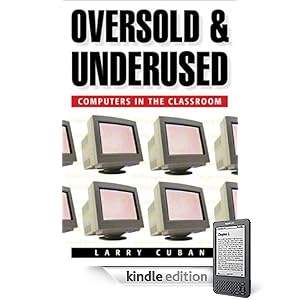 Cuban also mentions the need to alleviate the effects of poverty as one of his solutions that we need in order to address the ecology of schooling; among other things he writes, “the special needs of urban schools and low-income communities would require sustained attention to the links between economic, social, housing, and political structures of the neighborhood and schooling.”
Both Cuban and Christensen call for a drastic restructuring of schools before any technology can bring about change. Cuban concludes his book with this thought: “Without a critical examination of the assumptions of techno-promoters, a return to the historic civic and social mission of schooling in America, and a rebuilding of social capital in our schools, our passion for school-based technology, driven by dreams of increased economic productivity and the demands of the workplace, will remain an expensive, narrowly conceived innovation.”
While Christensen draws on his business experience, Cuban draws his conclusions from observations of what goes on in Silicon Valley schools. His descriptions of the unintended outcomes of computers in schools corroborates much of Christensen’s conclusions: Cuban finds no evidence of academic achievement as a result of vast expenditures on computers, he sees a sustaining of existing patterns of teaching, and very little evidence of student-centered, project-based, or interdisciplinary learning. Cuban offers a few plausible explanations for these unintended outcomes – the “slow revolution” and “history and context” explanations – but neither can explain the early adopter teachers that he profiles. What he learns from these “mavericks” is that in order to successfully integrate computers and education, teachers need to change their pedagogy.
Both authors realize the numerous obstacles in the way of this kind of reform. One such obstacle is the apparent lack of faith in teachers. Christensen suggests, “Don’t place artificial limits on what students can take online or what teachers can build online either... if they want to create content and lessons, let them do what they need to do, what they want, and what works best for them.” Cuban argues that schools need to rethink how time is allocated for teachers, that software needs to be developed specifically for teachers and students, and that products need to be tested by teachers and students before being sold to districts.
Both authors agree that teacher education needs to change as well.
Christensen says that we should stop training teachers them for a “world of monolithic, teacher-led content delivery, where the key skills are in holding students attention to subjects that are being taught to the dominant learner in each subject, trains teachers for the past.” I too agree that “future teachers will need the skills to work one on one with different types of learners as the study in student-centric ways. The tools that teachers build and distribute in the user networks of the future will play a key role in making learning student-centric. The next generation of teachers needs to learn how to build these tools for different types of learners.” However, to me it’s not an either-or. Future teachers and students need to master both skills – they need to be the guide by the side AND the sage on the stage.
Additionally Christensen’s agenda for graduate school research hit home as well, when he says that we need to “progress beyond doing descriptive research that seeks average tendencies.” His call to study anomalies and outliers and to understand why an action worked in one circumstance but not in another seems like pretty good advice to me. His definition of descriptive research made me realize that I’ve got to carefully consider my own research methodologies.
Ultimately though, Cuban’s conclusion spoke to me most. His discussion of social capital, the building trust and cooperation in society to keeping democracy vital, made a lot of sense to me. In the end he reminds us why we need reform done right. “Without a broader vision of the social and civic role that schools perform in a democratic society, our current excessive focus on technology use in schools runs the danger of trivializing our nation’s core ideals.” That philosophy needs to underpin all our efforts.
Additionally, given the fact that Christensen warns against the current view that schools function primarily to prepare a competitive workforce, I was leery of his reliance on so many business examples to illustrate his ideas for what’s needed in education reform. However the book takes off once the author describes the concept of disruptive innovation, “a process by which a product or service takes root initially in simple applications at the bottom of a market and then relentlessly moves ‘up market’, eventually displacing established competitors.” http://www.claytonchristensen.com/disruptive_innovation.html. The theory makes sense in the business world – Sony transistor radio, Ford Model T, Southwest Airlines, and the Toyota Prius are all businesses that illustrate his theory.
Despite my reservations, much of his business theory does make sense with regard to school reform, and what I’ve personally experienced as successful pedagogy. For example, I’ve been involved in the development of an educational social network called Youth Voices for a number of years now. Youth Voices fits at least some of the description of disruptive innovation in the sense that it wasn’t developed in my school or within my existing school structure, and that since it’s built on a Drupal CMS it’s pretty simple. (I suppose it would be at the “invention” level of integration using Cuban’s terms). It seems to be an example of a user network that’s student-centered and fosters interdisciplinary connections.
However, Youth Voices isn’t the complete separation that Christensen advocates. The composing that my students do in Youth Voices still originates out of a traditional face to face structure. Christensen instead seems to be arguing for separation, most notably in the form of a charter school. I like Christensen’s point that the charter school can serve as a R&D lab and that the lessons learned can be taken back to mainstream public schools to understand how to best meet the needs of our diverse learner population. I think it’s important to note that he says that the goal of the charter movement is not to create permanent replacements or competitors for public schools. To fit his model, charters have to be temporary from the outset. That flies in the face of the present charter school movement in Utah, where I live. To me it looks like much of the charter movement in my state is about segregating public schools, and entrenching or even further exacerbating the class distinctions.
Both Cuban and Christensen call for a drastic restructuring of schools before any technology can bring about change. Cuban concludes his book with this thought: “Without a critical examination of the assumptions of techno-promoters, a return to the historic civic and social mission of schooling in America, and a rebuilding of social capital in our schools, our passion for school-based technology, driven by dreams of increased economic productivity and the demands of the workplace, will remain an expensive, narrowly conceived innovation.”
While Christensen draws on his business experience, Cuban draws his conclusions from observations of what goes on in Silicon Valley schools. His descriptions of the unintended outcomes of computers in schools corroborates much of Christensen’s conclusions: Cuban finds no evidence of academic achievement as a result of vast expenditures on computers, he sees a sustaining of existing patterns of teaching, and very little evidence of student-centered, project-based, or interdisciplinary learning. Cuban offers a few plausible explanations for these unintended outcomes – the “slow revolution” and “history and context” explanations – but neither can explain the early adopter teachers that he profiles. What he learns from these “mavericks” is that in order to successfully integrate computers and education, teachers need to change their pedagogy.
Both authors realize the numerous obstacles in the way of this kind of reform. One such obstacle is the apparent lack of faith in teachers. Christensen suggests, “Don’t place artificial limits on what students can take online or what teachers can build online either... if they want to create content and lessons, let them do what they need to do, what they want, and what works best for them.” Cuban argues that schools need to rethink how time is allocated for teachers, that software needs to be developed specifically for teachers and students, and that products need to be tested by teachers and students before being sold to districts.
Both authors agree that teacher education needs to change as well.
Christensen says that we should stop training teachers them for a “world of monolithic, teacher-led content delivery, where the key skills are in holding students attention to subjects that are being taught to the dominant learner in each subject, trains teachers for the past.” I too agree that “future teachers will need the skills to work one on one with different types of learners as the study in student-centric ways. The tools that teachers build and distribute in the user networks of the future will play a key role in making learning student-centric. The next generation of teachers needs to learn how to build these tools for different types of learners.” However, to me it’s not an either-or. Future teachers and students need to master both skills – they need to be the guide by the side AND the sage on the stage.
Additionally Christensen’s agenda for graduate school research hit home as well, when he says that we need to “progress beyond doing descriptive research that seeks average tendencies.” His call to study anomalies and outliers and to understand why an action worked in one circumstance but not in another seems like pretty good advice to me. His definition of descriptive research made me realize that I’ve got to carefully consider my own research methodologies.
Ultimately though, Cuban’s conclusion spoke to me most. His discussion of social capital, the building trust and cooperation in society to keeping democracy vital, made a lot of sense to me. In the end he reminds us why we need reform done right. “Without a broader vision of the social and civic role that schools perform in a democratic society, our current excessive focus on technology use in schools runs the danger of trivializing our nation’s core ideals.” That philosophy needs to underpin all our efforts.
Guns, Germs ... and Human Natures
In order to see where we’re going, we need to understand where we’ve been; this is a central message in the two books by Jared Diamond and Paul Ehrlich. Guns, Germs, and Steel examines human history and explains how different societies from around the world progressed in different places at different paces. Human Natures: Genes, Cultures, and the Human Prospect takes a long evolutionary view and seeks to steer us on to a more earth-friendly course to the future.
 Guns, Germs, and Steel is framed around the questions of a New Zealander acquaintance of author Jared Diamond. Yali wants to know why Diamond’s culture has so much more cargo: “Why is it that you white people developed so much cargo and brought it to New Guinea, but we black people had little cargo of our own?” Diamond’s book is devoted to answering Yali’s question. Early in the book he states: “the strongest argument for writing the book is to combat racism.” Diamond has great respect for the native New Guineans, and even gives reasons why he considers them a more intelligent people than Western culture. By answering Yali’s question he is refuting racist arguments and assumptions that are still common in our society today.
A long time ago environmental factors influenced whether humans would be farmers or herders. It turned out that this distinction accounted for a big difference. Farmers developed agriculture, which supported more people per acre. This in turn led to food surpluses which then allowed for specialization in society – some members of the population could be artisans, others warriors, weapons makers, or scribes. Additionally domestication of animals allowed for eventual immunity to the germs that would wipe out entire nations of indigenous peoples in many areas that we now refer to as Third World countries. All of this explains, for example, how Pizarro’s band of 168 Spaniards conquered a foe 500 times its size. They had the advantage of steel, germs, and writing. Diamond concludes: “The striking differences in the long-term histories of peoples is not due to innate differences in the people themselves but to differences in their environments.”
Two of the most significant reasons explaining the ability of some cultures to conquer other peoples are attributed to the continental differences in the wild plant and animal species available for domestication, and the rates of continental diffusion, which facilitated the dissemination of important innovations like technology and writing. The factors that allowed for successful domestication led to denser populations, which in turn allowed for innovation and diffusion of new technologies and ideas. Throughout history societies that had these advantages have conquered those that didn’t. In the end Diamond shows that there’s not racial superiority in human cultures, just that more fortuitous circumstances for some led to domination over others.
The most personally relevant point in Diamond’s book is his belief that native peoples are actually more intelligent than Westerners. What that means for me as an educator is that the more my students and I connect with people from other cultures via the Internet, the more we have to learn from all peoples, not just those from the West. It’s optimistic but my hope is that the Internet can foster learning exchanges from all peoples of the world, since it’s clear from both books that we as a species have a lot to learn.
While Diamond’s point is an important one, I actually found many more points in Ehrlich’s book that are personally relevant to my role as an educator and as a human. All these connections are ultimately due to one cause – the difficulty of humans as small-group animals to come to grips to the global impact of our actions.
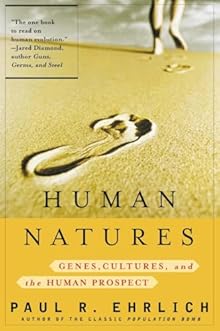 Ehrlich is also interested in the large sweep of the human enterprise, and begins in a similar vein. In fact both writers rail against the evils of racism; Diamond to refute racial superiority theories and Ehrlich to cite racism as one of the hurdles facing our cultural evolution. Ehrlich begins his book by stating that there is no such thing as just one “human nature.” The skills and adaptations needed to navigate the savanna, for instance, differed from those needed to be successful in a deciduous forest. Still Ehrlich notes that despite our many differences in our genetic evolution, all humans share the common similarity of being small-group animals. The author asserts that this background hinders our progress as we increasingly impact the world: “We have barely begun to solve the problem with which cultural evolution has presented us: how to live in large groups, perpetually intensifying our activities, creating technologies few of us can understand and even fewer can control, without sowing the seeds of our own destruction.”
Ehrlich’s warnings are clear about the ways humans are negatively impacting the world: “There’s no controversy about the damage modern states are inflicting on the environment... Multinational corporations seldom have any strong connection to a particular nation ... their interest is above all in global profitability ... the UN and IPCC have not gained significant regulatory control over the way human beings treat one another and their rapidly deteriorating life support systems....” The ever-increasing power of multinational corporations and the inability to regulate them has been made clear in recent movies like Food Inc. and Tapped that detail how corporations are taking control of our food sources and our water with very little governmental oversight.
This scenario could portend a depressing future if Ehrlich had ended there. But he does provide hope. He argues that since we’ve solved imposing social problems in the past, we can do it again. “The potential for conscious evolution exists,” he says, “is patent in the great social movements that societies have already experienced: the abolition of slavery, the trend toward democratic governments and individual expression, innovation over position, the labor movement, the civil rights movement, the environmental movement.”
So how do we get there? How do we as educators facilitate this “conscious evolution”? One key is how we teach our students to use technology wisely and for the common good: “The capacity to develop ethics is a product of biological evolution, the ability to anticipate the consequences of one’s actions, a critical capacity for empathy, a capability to internalize the moral standards of society and make value judgments, and free will. The products of that ethical capacity – the ethics, morals, and norms of a society – are the result of cultural evolution.”
Ultimately it’s about how we help our students foster empathy by cultivating the conscious evolution from a small group animal to one with a global consciousness is through establishing relationships with other cultures via the world wide web. Ehrlich states that “human beings have evolved some limits to the arousal of empathy.... the urge is particularly strong when the victims are depicted as individuals with whom one can identify rather than as anonymous individuals....”
Clearly one way is to help students forge connections with other cultures, so that the youth of these cultures can engage in meaningful and productive ways. Once students aren’t anonymous to each other, empathy soon follows. For example, I’ve personally seen this happen when my students collaborated with Inuit students in the Marshall School on the Yukon river in Alaska (here’s a link to a podcast that documents the teachers’ collaboration and here’s a link to our shared WikiSpaces page). My students learned how climate change is profoundly affecting the lives of their peers in Alaska, and came away with a much more personal view of this global issue. Meaningful connections like these can go a long way toward a conscious evolution.
Yet just making these connections doesn’t necessarily lead to changes in behavior. Ehrlich warns that repeated exposure to global issues, without opportunities to take action, can also lead to habituation. For instance, I’ve been involved in a collaboration with other teachers this fall on the site Voices on the Gulf. In an except from a recent dialogue on the site, Emily, one of my students responds to a post:
Our students know that there are problems of a global scale out there and they have the ability to connect with their peers from around the globe, but they also need to learn how to critically examine information so that they can act on knowledge and facts. This call to action by Ehrlich, coupled with Diamond’s belief in the underappreciated wisdom of native peoples makes a compelling case for fostering inclusive world-wide learning networks to deal with the global problems we’ve created.
A long time ago environmental factors influenced whether humans would be farmers or herders. It turned out that this distinction accounted for a big difference. Farmers developed agriculture, which supported more people per acre. This in turn led to food surpluses which then allowed for specialization in society – some members of the population could be artisans, others warriors, weapons makers, or scribes. Additionally domestication of animals allowed for eventual immunity to the germs that would wipe out entire nations of indigenous peoples in many areas that we now refer to as Third World countries. All of this explains, for example, how Pizarro’s band of 168 Spaniards conquered a foe 500 times its size. They had the advantage of steel, germs, and writing. Diamond concludes: “The striking differences in the long-term histories of peoples is not due to innate differences in the people themselves but to differences in their environments.”
Two of the most significant reasons explaining the ability of some cultures to conquer other peoples are attributed to the continental differences in the wild plant and animal species available for domestication, and the rates of continental diffusion, which facilitated the dissemination of important innovations like technology and writing. The factors that allowed for successful domestication led to denser populations, which in turn allowed for innovation and diffusion of new technologies and ideas. Throughout history societies that had these advantages have conquered those that didn’t. In the end Diamond shows that there’s not racial superiority in human cultures, just that more fortuitous circumstances for some led to domination over others.
The most personally relevant point in Diamond’s book is his belief that native peoples are actually more intelligent than Westerners. What that means for me as an educator is that the more my students and I connect with people from other cultures via the Internet, the more we have to learn from all peoples, not just those from the West. It’s optimistic but my hope is that the Internet can foster learning exchanges from all peoples of the world, since it’s clear from both books that we as a species have a lot to learn.
While Diamond’s point is an important one, I actually found many more points in Ehrlich’s book that are personally relevant to my role as an educator and as a human. All these connections are ultimately due to one cause – the difficulty of humans as small-group animals to come to grips to the global impact of our actions.
Ehrlich’s warnings are clear about the ways humans are negatively impacting the world: “There’s no controversy about the damage modern states are inflicting on the environment... Multinational corporations seldom have any strong connection to a particular nation ... their interest is above all in global profitability ... the UN and IPCC have not gained significant regulatory control over the way human beings treat one another and their rapidly deteriorating life support systems....” The ever-increasing power of multinational corporations and the inability to regulate them has been made clear in recent movies like Food Inc. and Tapped that detail how corporations are taking control of our food sources and our water with very little governmental oversight.
This scenario could portend a depressing future if Ehrlich had ended there. But he does provide hope. He argues that since we’ve solved imposing social problems in the past, we can do it again. “The potential for conscious evolution exists,” he says, “is patent in the great social movements that societies have already experienced: the abolition of slavery, the trend toward democratic governments and individual expression, innovation over position, the labor movement, the civil rights movement, the environmental movement.”
So how do we get there? How do we as educators facilitate this “conscious evolution”? One key is how we teach our students to use technology wisely and for the common good: “The capacity to develop ethics is a product of biological evolution, the ability to anticipate the consequences of one’s actions, a critical capacity for empathy, a capability to internalize the moral standards of society and make value judgments, and free will. The products of that ethical capacity – the ethics, morals, and norms of a society – are the result of cultural evolution.”
Ultimately it’s about how we help our students foster empathy by cultivating the conscious evolution from a small group animal to one with a global consciousness is through establishing relationships with other cultures via the world wide web. Ehrlich states that “human beings have evolved some limits to the arousal of empathy.... the urge is particularly strong when the victims are depicted as individuals with whom one can identify rather than as anonymous individuals....”
Clearly one way is to help students forge connections with other cultures, so that the youth of these cultures can engage in meaningful and productive ways. Once students aren’t anonymous to each other, empathy soon follows. For example, I’ve personally seen this happen when my students collaborated with Inuit students in the Marshall School on the Yukon river in Alaska (here’s a link to a podcast that documents the teachers’ collaboration and here’s a link to our shared WikiSpaces page). My students learned how climate change is profoundly affecting the lives of their peers in Alaska, and came away with a much more personal view of this global issue. Meaningful connections like these can go a long way toward a conscious evolution.
Yet just making these connections doesn’t necessarily lead to changes in behavior. Ehrlich warns that repeated exposure to global issues, without opportunities to take action, can also lead to habituation. For instance, I’ve been involved in a collaboration with other teachers this fall on the site Voices on the Gulf. In an except from a recent dialogue on the site, Emily, one of my students responds to a post:
However, now that we're after the fact, we can all make conscious decisions to rehabilitate and renew the Gulf. What those actions would be, I don't know--I'm in agreement with the author on this post that BP has failed to offer any real specifics as to what they're doing to fix the situation. But give me something to do in order to help, and I will do it.
Our students know that there are problems of a global scale out there and they have the ability to connect with their peers from around the globe, but they also need to learn how to critically examine information so that they can act on knowledge and facts. This call to action by Ehrlich, coupled with Diamond’s belief in the underappreciated wisdom of native peoples makes a compelling case for fostering inclusive world-wide learning networks to deal with the global problems we’ve created.
Subscribe to:
Posts (Atom)