If you're a teacher looking for an simple outdoor activity that could be adapted for a wide range of ages, here's an idea from the
National Writing Project's writeout resources. This year's writeout takes place from October 10-24.
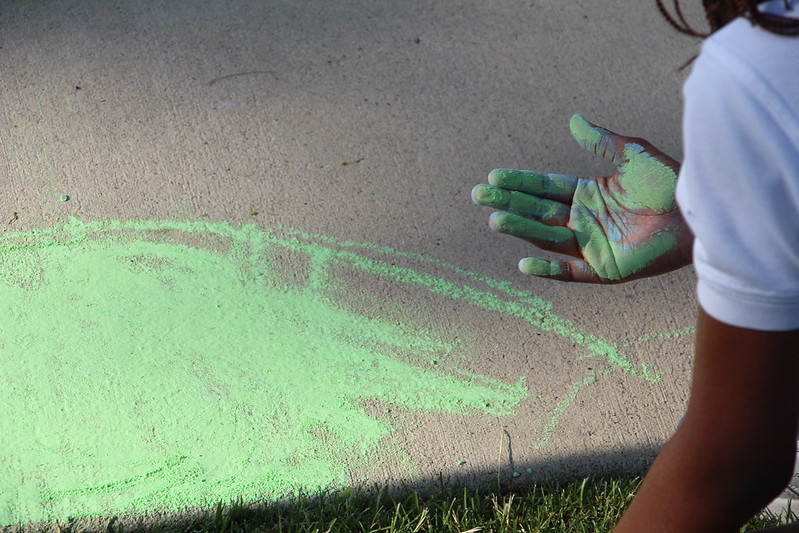
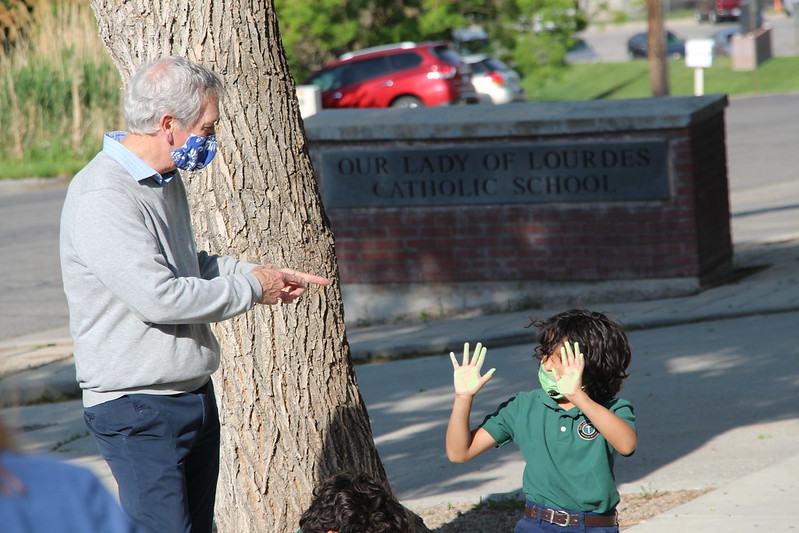
I teach high school but recently I volunteered to teach a writing and photography workshop to 4th graders at a nearby school. Well, I originally planned to do a photography workshop, but with a pandemic at hand it didn't make sense for students to be handing cameras back and forth to each other and to me – so the medium of choice became sidewalk chalk.
Step One, before the workshop
I started by finding out what the students had been learning, and it turned out that they'd been working on poetry (metaphors) and learning about John Muir.
Step Two, writing activity
"I drifted about from rock to rock, from stream to stream, from grove to grove. Where night found me, there I camped. When I discovered a new plant, I sat down beside it for a minute or a day, to make its acquaintance and hear what it had to tell... I asked the boulders I met, whence they came and whither they were going." – John Muir, John of the Mountains
Then we talked about finding poetry in prose. So we brainstormed the following poem based on that Muir quote:
When I discover a new plant,
I sit down beside it for a minute or a day.
I make its acquaintance and hear what it has to say.
Next we had a discussion about how trees "talk" to each other, based on a video by Ranger MacKenzie of the Sequoia & Kings Canyon National Parks, which can be found on
this NWP resource. Depending on the age of your students, you might just use these talking points from the video:
- What are acorns? Where do they come from? Who eats them?
Acorns are eaten by bears, deer, birds, squirrels, mice, worms.
- One mature oak tree can drop over 10,000 acorns in a year
- Every 2-5 years oak trees coordinate in an event called masting, where they all drop thousands and thousands of acorns. Some will be buried and forgotten by squirrels, and will grow to be mature oaks. More on masting from the Washington Post.
Discussion question
How can trees talk to each other, even when they are spread apart in a forest for sometimes hundreds of miles? Answer: Tree roots are covered with microscopic fungi that tie trees together so that they can talk to each other.
Read this Smithsonian article for a more detailed answer. Fyi, I've summarized key points from the article at the bottom of this post.
Journal
Students write a paragraph and then a poem about a real or imagined tree and what they think it would talk about.
Step Three, go outside
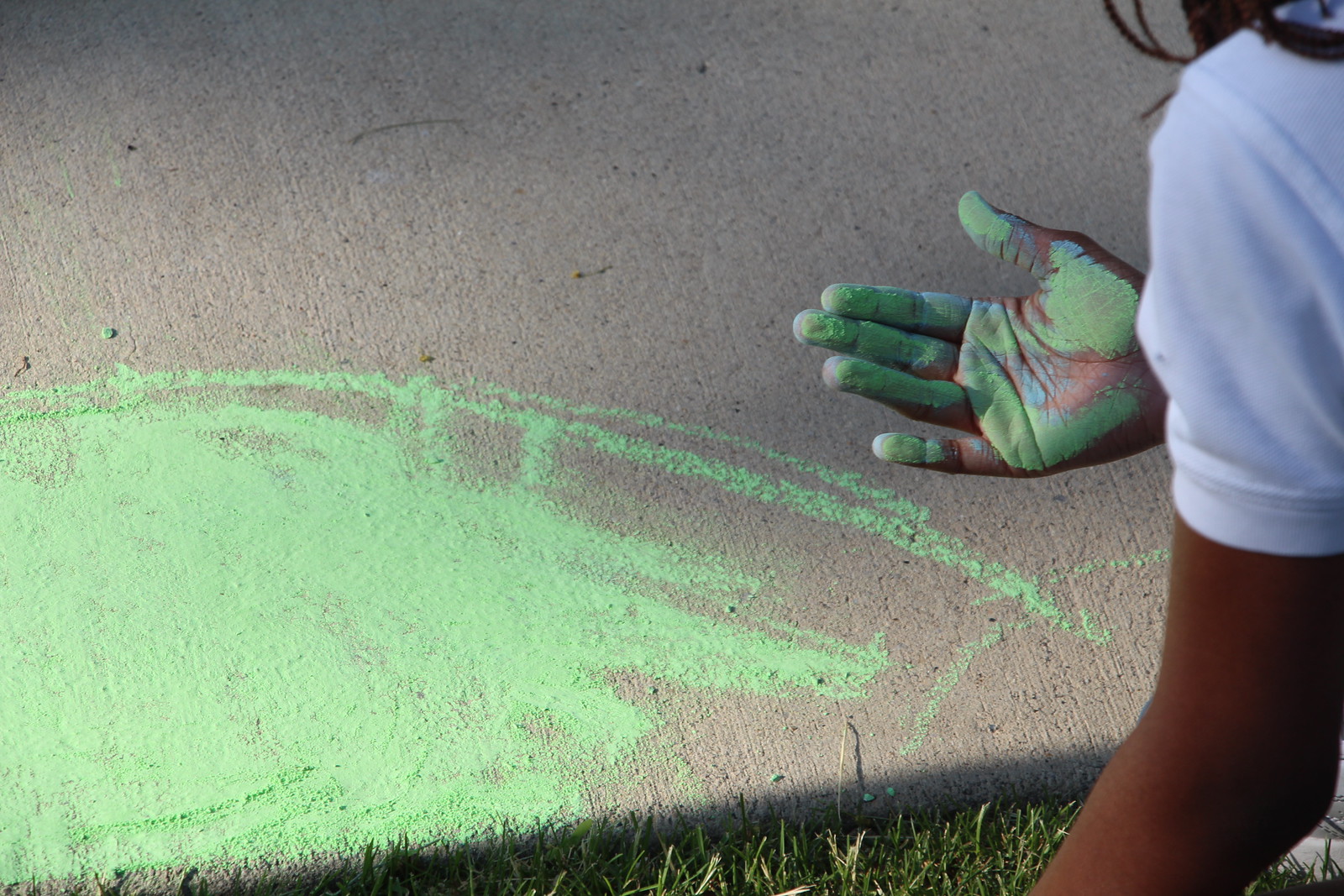
Loaded with lots of sidewalk chalk, students go outside and claim one square of a nearby sidewalk. They draw their tree and include at least one sentence of what the tree would say if it could talk. After about a half hour of drawing, we finish with a celebratory gallery walk where the artists discuss their creations and read their words.
Summary of the Smithsonian article mentioned above:
- Forest trees have evolved to live in cooperative, interdependent relationships, maintained by communication and a collective intelligence similar to an insect colony.
- Some are calling it the ‘wood-wide web,
- Trees share water and nutrients through the networks,
Use the fungi to communicate.
- They send distress signals about drought and disease, for example, or insect attacks, and other trees alter their behavior when they receive these messages.”
Scientists call these mycorrhizal networks. The fine, hairlike root tips of trees join together with microscopic fungal filaments to form the basic links of the network, which appears to operate as a symbiotic relationship between trees and fungi, or perhaps an economic exchange. As a kind of fee for services, the fungi consume about 30 percent of the sugar that trees photosynthesize from sunlight. The sugar is what fuels the fungi, as they scavenge the soil for nitrogen, phosphorus and other mineral nutrients, which are then absorbed and consumed by the trees.
- To communicate through the network, trees send chemical, hormonal and slow-pulsing electrical signals, which scientists are just beginning to decipher. Edward Farmer at the University of Lausanne in Switzerland has been studying the electrical pulses, and he has identified a voltage-based signaling system that appears strikingly similar to animal nervous systems (although he does not suggest that plants have neurons or brains)
- Monica Gagliano at the University of Western Australia has gathered evidence that some plants may also emit and detect sounds, and in particular, a crackling noise in the roots at a frequency of 220 hertz, inaudible to humans.
- Trees also communicate through the air, using pheromones and other scent signals. Wohlleben’s favorite example occurs on the hot, dusty savannas of sub-Saharan Africa, where the wide-crowned umbrella thorn acacia is the emblematic tree. When a giraffe starts chewing acacia leaves, the tree notices the injury and emits a distress signal in the form of ethylene gas. Upon detecting this gas, neighboring acacias start pumping tannins into their leaves. In large enough quantities these compounds can sicken or even kill large herbivores.
- Giraffes are aware of this, however, having evolved with acacias, and this is why they browse into the wind, so the warning gas doesn’t reach the trees ahead of them. If there’s no wind, a giraffe will typically walk 100 yards— farther than ethylene gas can travel in still air—before feeding on the next acacia. Giraffes, you might say, know that the trees are talking to one another.
- Trees can detect scents through their leaves, which, for Wohlleben, qualifies as a sense of smell. They also have a sense of taste. When elms and pines come under attack by leaf-eating caterpillars, for example, they detect the caterpillar saliva, and release pheromones that attract parasitic wasps. The wasps lay their eggs inside the caterpillars, and the wasp larvae eat the caterpillars from the inside out. “Very unpleasant for the caterpillars,” says Wohlleben. “Very clever of the trees.”
- A recent study from Leipzig University and the German Centre for Integrative Biodiversity Research shows that trees know the taste of deer saliva. “When a deer is biting a branch, the tree brings defending chemicals to make the leaves taste bad,” he says. “When a human breaks the branch with his hands, the tree knows the difference, and brings in substances to heal the wound.”
- Mother trees are the biggest, oldest trees in the forest with the most fungal connections. They’re not necessarily female, but Simard sees them in a nurturing, supportive, maternal role. With their deep roots, they draw up water and make it available to shallow-rooted seedlings. They help neighboring trees by sending them nutrients, and when the neighbors are struggling, mother trees detect their distress signals and increase the flow of nutrients accordingly.
- One teaspoon of forest soil contains several miles of fungal filaments.
- Why do trees share resources and form alliances with trees of other species? Doesn’t the law of natural selection suggest they should be competing? “Actually, it doesn’t make evolutionary sense for trees to behave like resource-grabbing individualists,” she says. “They live longest and reproduce most often in a healthy stable forest. That’s why they’ve evolved to help their neighbors.”
- Wohlleben’s first priority is to not be boring, so he uses emotional storytelling techniques. His trees cry out with thirst, they panic and gamble and mourn. They talk, suckle and make mischief.