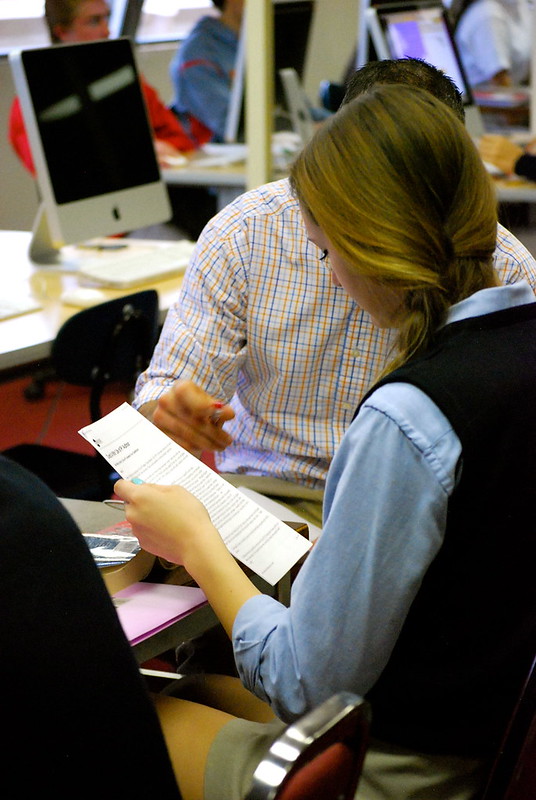
Teaching during the days up to and right after the holidays can be a challenge. Try having your students compose hand-written Thank You notes to a former teacher if you're looking for a quick activity around Thanksgiving and other holidays.
We did this in class today, and within a half hour my students wrote honest, poignant missives which of course is good in and of itself. But there's research to back it up why it's good for the people who receive the notes. In an article in Psychological Science, Kumar and Epley (2018) found that the people who received gratitude letters, "significantly underestimated how surprised recipients would be about why expressers were grateful, overestimated how awkward recipients would feel, and underestimated how positive recipients would feel."
Most of the notes were to people who were still teaching in our city, so my administration agreed to hand deliver them to those schools. Looking forward to what my students hear back from their former teachers.
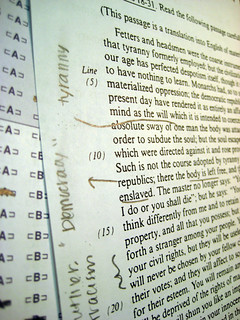
In the book Words Onscreen, author Naomi Baron cites research that might surprise you: When it comes to reading for school, today’s students prefer reading on paper over reading onscreen. According to Baron, our students may compose copious amounts of digital writing on their personal devices, but when it comes to close reading, students still prefer printing a PDF and annotating it with a pencil in hand.
Baron cites a study from late 2013 whose findings show that 84% of U.S. college students say they prefer print over digital text because it’s easier to bookmark and highlight. Baron readily admits this may change with time: “Annotation becomes easier on digital devices, especially for those who practice” (p. 30).
There’s no doubt that our students will get a lot more practice annotating online. In fact, annotating the Web is nothing new. The developers of Mosaic, one of the earliest browsers from the ’90s, envisioned a Web that anyone could annotate. And there’s no shortage of web annotation tools—Bounce, Diigo, and Genius, to name a few.
Hypothes.is screenshot
But over the past couple of years the two annotation tools that I've used most in my teaching areNowComment and Hypothes.is.
In celebration of Martin Luther King, Jr., I put together some resources for ELA teachers to help students appreciate the language Dr. Martin Luther King, Jr.
First his "I Have a Dream" speech is significant for many reasons, but it's also worthwhile to appreciate the elegance of the words themselves. It's one thing to say that the speech is powerful, but it's another to identify reasons that account for that power. That's what this lesson is meant to do (link to the PDF).
I also want my students to understand that "Letter from Birmingham Jail" is an important document historically, of course, but also rhetorically. It's one of the best written documents in American history. Here's a doc I put together that explains a few reasons why.
How do you start each class? In my last post I talked about ways to start the school year, but what about every day after that? The first few minutes set the tone for how the rest of the session goes. Some of the teachers I know have an opening quote on the board that the students respond to as soon as they walk in the door. After 10 minutes they invite students to share their responses; otherwise, move on to the day's lessons. Activities like this and the ones below allow teachers time to do attendance, touch base with students, etc. while still giving students a meaningful task. Here are ways I begin my classes.
Greetings
When possible greet the students at the door. I can't always be at the door when they arrive, but when I am, I always welcome them to the day's class. I do this because I'm genuinely happy to see them.
Silent reading or writing
This year the AP English Language students will read from a nonfiction book of their choice for the first 10-15 minutes of class. The goal of this assignment is to complete at least one nonfiction book a semester. That allows a slower reader to choose a long book and time enough to complete it. If students finish a book, they move on to another.
Students share the load
Why should teachers have to do all the work? Once the class has completed some preliminary discussions about writing style, I have students do some of the work of beginning the day. At least once a quarter students are responsible for choosing a passage from their free-reading book to share with the class. Here's a link to the assignment that I collaborated on with my colleague Bryan Jeffreys. Even if you don't have students choose a passage from their reading, I've seen variations of this activity where students choose some inspirational words, read them to the class, and then read aloud their reflection on why they personally consider that quote inspirational.
It's been said that we never get a second chance to make a first impression. The same can be said for each class we teach.
We all want to start school off on the right foot. If you're an English Language Arts teacher here are are some ideas my English department colleagues and I came up with.
Read a favorite poem of yours, ask the students to write a response, and then share your own. My colleague Linda Simpson starts with "Being a Person" or "Just Thinking" by William Stafford.
My colleague Matt Vanderlaan has people Interview a partner and compose a feature like Time Magazine's 10 Questions. Here's a link to my multimedia profile assignment that I adapted from Matt's original idea.
In another class I have students write about what their teacher should know about them as readers and writers (see below).
My Reading History assignment
Reading is one of the most valuable things we do. As we work to develop our skills, it is helpful to understand how our attitudes have been formed. Please write a letter to your teacher about your history as a reader. Include answers to as many of the following questions as you can in your letter/personal history.
Favorite childhood/bedtimes stories (who read to you?) Describe.
What are some of your earliest book memories? Anything funny happen?
Who in your home read? Parents? Older brothers/sisters? grandparents?
What magazines or books were in your home?
Who read to you in pre-school or the library? What books were your favorites?
What were your favorite TV shows as a child? Describe. Can you remember any favorite commercials or jingles?
What teacher/s taught you to read in school? Describe how they taught you. What did teachers read to you? Which books were your favorites?
Did you enjoy reading in school? Did you enjoy reading aloud in class?
In Junior High Did you read more or less frequently? Explain. Did your friends read? Did this make a difference to you?
Best book you’ve ever read and what made it the best
Worst book you’ve ever read and what made it the worst
Magazines or newspapers you look at regularly
Where and when you enjoy reading most
What book you are reading at the present time?
What books are you considering reading next?
If you buy books and keep them, where do you keep them?
If I've learned one thing in the decades I've been a teacher, it's that our students have powerful voices that need to be heard. Given the public discourse that's happening these days, it's more important than ever that our students have a say. The PBS NewsHour Student Reporting Labs provides a platform to accomplish these goals, with programs for teachers as well as students. Below are some of the resources from today's presentation at UCET 2016.
Programs for students and teachers
A great opportunity for your aspiring journalists is the all-expense paid, week-long SRL Academy each summer in Washington D.C. Although the application deadline for this year's Academy has passed, look for applications next winter. Judge student Alex Maxwell participated in this program in the summer of 2015. Also keep an eye out for the SRL Apprenticeship Program, which Judge student Mary Oliver will be attending this summer.
2015-16 Student Reporting Labs at Judge Memorial
I highly recommend the Summer Teacher Boot Camp in Washington DC, which I attended in 2014. Teachers can apply for that in the spring of each year.
Student videos
This past fall, the Outside the Box series looked at how preconcieved notions of gender and affect the lives of middle and high school students. My students contribution - Let's Dance
In the fall of 2014, Student Reporting Labs from around the country produced stories of teens who make a difference in their community. This feature by students at Judge Memorial, Serving Those who have Served, was featured on the 2014 Christmas Day PBS NewsHour show.
Last spring another SRL school was a Winner of White House Film Festival; my students video received an Honorable Mention in that same contest.
How will you incorporate the 2016 elections into your curriculum?
I'm putting together resources around the 2016 election, like I did for the 2012 elections. This fall the books I'll teach are Julius Caesar,1984 and Unspun: Finding Facts in a World of Disinformation. Although Unspun was written about ten years ago, the concepts are still relevant today. For example this year I had students update Unspun with examples from 2015. Here's a link to the assignment.
My student, Alex, and I on Utah Conversations. Link to show.
I recently appeared on Utah Conversations on KUED, and much of this episode of the show centered on the future of journalism. My class is a PBS NewsHour Student Reporting Lab, one of about 100 around the U.S., and my student Alex was fortunate enough to be a fellow this summer with them in Washington D.C. Some of the things the seasoned journalist, Ted Capener, was curious about was whether students have changed over the past few decades and how today's youth use media.
A lot of teachers have their students use online discussions in their classes. Whether you use a closed blog that's only for members of your class or whether you have a more open structure where your students communicate with students around the world, you've probably come across motivation issues.
One thing I noticed a while back is that when my students received a lot of unsolicited feedback from students at other schools, they were initially excited with the sheer volume of responses. I would overhear conversations like this:
Student 1: "I got 12 comments on my post."
Student 2: "I got 15"
Student 3: "I heard Larry got 22."
These comparisons would go on until the students started reading the comments. Once they critically examined the comments they received, the conversation then focused on the quality of those comments. I recently published a study in the Journal of Educational Computing Research that examines the relationship between motivation and the quantity and quality of comments my high school students received on their Youth Voices discussions. I looked at motivation through the lens of Self-Determination Theory, specifically how comments affected students' sense of relatedness, perceived competence, interest, and value.
I found that while the quantity of comments received was related to two motivational factors, the quality of the comments was related to all four motivational comments. As a teacher what I've learned in practice and through this research study is that I think it's best when my own students comment at least twice as often as the actual posts they write. And more importantly, I've learned that teachers need to be clear in their conversations with students about what makes good comments. Some traits my students mentioned most frequently: the commenter took the time to understood the writer's perspective, the commenter took the writing seriously and was viewed as competent, the comment addressed specific aspects of the post, and the comment extended/added to/challenged the writer's thinking.
For the past year I've been doing a bit of writing around tools that facilitate reading and writing on the web. In an article I wrote for the International Literacy Association, Annotating Online, I do some reviews of applications like Citelighter, Diigo, Crocodoc, and Mendeley. They all have their strengths for helping students write and collaborate while they conduct research
Another article I wrote for the ILA, Online Peer Reviews Improve Literacy Instruction, is about how I use Eli Review in my classes. In the article I also cite decades of research that have found that peer review not only helps writers improve, but even the act of peer review helps students improve as writers.
A former student of mine, now in education herself, posed this question on Facebook: "Teacher friends, tomorrow is the day before a vacation [Thanksgiving]. How are you addressing the [Ferguson] grand jury announcement."
Still from Carlos' upcoming video
My response is longer than seemed appropriate for a Facebook comment box, so here goes...
First of all, I'll reframe the question: how have I been and how will I address the issues around Ferguson in my own media studies classroom? It really began on the first day of school this year when a student asked me if I'd been keeping up on "what was going on in Missouri." That student's question and a Teachers Teaching Teachers show with Dr. Marcia Chatelain prompted a piece that I wrote for the Guardian. PBS NewsHour also published How to talk to students about Ferguson written by Dr. Chatelain that's a great resource for educators.
Speaking of NewsHour, since we're a Student Reporting Lab my students' work was also featured on the NewsHour segment Teens reflect on impact of Ferguson unrest. Their work and that of the other schools in this segment shows thoughtful, student-produced commentary. So, in addition to addressing the opening question, I think it's important that educators not only discuss these kinds of issues in schools, but also share the wisdom that's generated by our youth with a larger audience. Our students have perspectives that need to be included in our civic dialogue.
An amazing resource for educators to bring timely civics issues like Ferguson into the classroom is KQED Do Now (if you're a science or arts teacher, there are also relevant activities for your students too). The weekly Do Now discussion for September 26, Should the members of a police force reflect the larger population? had approximately 600 comments from students from around the country. My students summarized that discussion for a Do Now Round Up in October, Diversity and police departments.
For many years I've collaborated with Paul Allison on youthvoices.net, which hosts the discussions of students in the classes of teachers mostly associated with the National Writing Project, but open to all educators. If you want to get a look at what teens are thinking, here's a sampling of the Youth Voices discussions about Ferguson and related issues.
One of the things I try to stress in all my teaching is the idea of perspective taking, where students consider complex issues from multiple angles. Harvard's Visible Thinking protocol, Circle of Viewpoints, is one way to foster productive discussion around sensitive issues like Ferguson by considering the perspectives of many different stakeholders.
For example, a student of mine has interviewed members of our local police department to find out how they are responding to incidents like the Mike Brown shooting in our own community (e.g. Dillon Taylor, Darrien Hunt). By the way, this student journalist I'm talking about is the one I mentioned in the third paragraph, the one who asked about the events of Ferguson on the first day of school this year. While his classmates race out the door at the end of the day today for Thanksgiving holiday, he'll stay after school to finish his video.
These curricular conversations have been happening over the Ferguson issue and other important ones throughout the year and will go on long after the media storm passes. To me what's important is the role that media creation and productive online discussion has in the lives of our students, our future leaders.
Some of the happiest and most effective teachers I know are the ones that incorporate the concept of making in their teaching. Personally I see it in arts teachers when they're preparing for a showing or performance, or the chemistry teacher in the lab.
At today's conference David Perkins set the tone by noting how, among other things, the maker movement transcends traditional disciplines and prescribed studies. That sentiment was amplified in a session by Jen Ryan who discussed the Agency by Design (AbD) research done with Shari Tishman and Edward P. Clapp, that's identified two core concepts – making empowers learners and that empowerment leads students to recognize that they are fully capable of redesigning their world for the better. At the end of the day, Daniel Wilson noted that much of Project Zero's nearly 50 years of research has shown that learning is active, social, and visible.
Since making is a prominent feature of the conference and in education today, I thought I'd share some of the maker projects of the adult students I worked with this summer in the Michigan State University Master's in Educational cohort in Galway, Ireland. It showed me again how joyful teaching can be when we make things.
If you're a writing teacher, you've probably encountered the following situation: a colleague from another discipline waves a student paper at you and complains "these kids can't write." It happens to me at least once a year.
In the past I've told these colleagues that maybe the assignment wasn't clear enough or that perhaps they should treat this as a draft, as another step in the writing process, that surface errors are most likely related to performance – not competence. But a lot of times content area teachers don't plan on doing multiple drafts of a paper, and I sense that they walk away from our conversation even more convinced that student writing skills are on a gradual decline.
But I just came across a book that sheds more light on this. According to Lee Ann Carroll in Rehearsing New Roles: How College Students Develop as Writers, research shows that student writing appears to be weaker when they encounter new and unfamiliar expectations. Student writing develops because they must take on new and difficult roles in a discipline that they've probably never encountered before. It's reasonable to assume that students' new learning is creating all the cognitive load and that their early writing reflects this.
This all reminded me of the 1972 Donald Murray essay, "Teach Writing as a Process, Not Product." In the essay, Murray notes that since most English teachers were trained to analyze a product like a sonnet by Shakespeare and that they focus their critical attention on student writing as if it were a product. According to Murray, the problem with that approach is that a teacher's "attack does little more than confirm the student's lack of self-respect for their work and for themselves." Murray instead argues that teachers should "glory in the unfinishedness"of student writing.
So now when a colleague approaches me with the complaint that writing teachers like me aren't doing enough to prevent the next generation's slow slide into illiteracy, I've got another answer. Content area teachers might anticipate initially weaker writing as students deal with new concepts in unfamiliar disciplines – that's a sign that they're learning.
Then I'll advise them to make sure their assignments are clear and to build in some time for revision.
Whether it's the holidays or some other special occasion, homemade gifts are often the best ... and cheapest to make. Everybody's got photos, and everybody can make stuff out of them. Here are some DIY photo projects my students did in my photography class this year.
Paul Salopek has embarked on a seven-year Out of Eden walk across the earth to create a "global mosaic of stories." I'm looking forward to talking with the people from the Out of Eden Learn team later today about their efforts to create a community of learners around Salopek's journey. Join us here if you want to learn more.
On February 5 my photography students will be having their own DIY photo gear film festival. I've written before (and even before that) about how students show themselves to be capable teachers if given the chance; this is another example of what happens when we put students more in charge of their own learning. The assignment was to create some do-it-yourself photography gear on a shoestring budget. For example, the video below shows how one of my students created a stabilizer for $25, a piece of equipment that could run as much as much as $200 if purchased retail.
Here are some of the other student videos: Lupita, Cassadey, Gaby, Evan, Sean, Claire, Sarah, Allegra and Steven. One of the common denominators in these projects is the joy that can be seen in the making of these projects. Of course they also learned a lot in the process. The next step in this sequence is for these same students to use these pieces of equipment in the documentary they're producing this quarter. Should be interesting.
Maybe because it was the end of autumn and I'd just harvested the last of the veggies from my own yard, maybe I was just hungry, but whatever the case when I was at the NCTE annual convention this November I attended two workshops that focused on food. One workshop, maybe the best I've ever attended at NCTE, showcased a partnership between BreadLoaf with students from the Navajo Nation and at Fern Creek High School in Louisville, Kentucky – the Navajo Kentuckians. The Navajo students and the teachers from Kentucky provide a powerful example of what can happen when educators mix food and learning. Students in the Louisville school have even shown gains on recent state tests that, according to the teachers, are due in part to their program. Another presentation at NCTE shared what Dr. Alan Webb and colleagues have been collecting at FoodCurriculum.com a website that has lots of good info and resources for teachers interested in starting some edible education.
In addition to dedicated and passionate educators, something that stands out about the efforts mentioned above is their cross-curricular nature. Students are connecting literacy, chemistry, biology, business, botany, health, and politics, to name a few – and the they're highly engaged in the learning. And maybe most significantly, a common denominator in all these stories is how they're transforming their communities for the better.
November 19, 2013, is the sesquicentennial of the Gettysburg Address. Learn the Address and Getty Ready are two quality educational resources that have been created to help all of us appreciate that 272-word speech. Like a lot of teachers, my students and I will analyze the text of the speech and even get to attend a webinar with Ken Burns on November 18. But as I look over the Address in preparation of the anniversary this week, I can't help but contrast the disingenuous rhetoric of current elected officials to Lincoln's dignified language.
As an English teacher I marvel at the Address every time I read it. There's the elegance of the sentences – the antithesis and epiphora – and the subtlety of the asyndeton. And there's the diction – the repetition of "dedicate"; the optimistic tone of the Address due to words like noble, endure, live, struggled, consecrated, brave, resolve. Finally there's Lincoln's deft craftmanship, the movement through time and place as the speech unfolds. The paragraphs progress from the past "four score and seven years ago" to the "now," and finally to the future, to the vital "unfinished work" of the "great task remaining before us." The speech physically takes the reader from the continent to the battlefield as a whole and ultimately to "this ground" where the people were gathered for the Address. (This all is summarized in the presentation that I share at the bottom of this post.)
That's how I think of the document as an English teacher....
But as a citizen I can't help celebrating the 150th anniversary of the Gettysburg Address without wondering what Abraham Lincoln would think of the people who now lead us. I think he'd be disappointed in our many politicians who choose self-interest over problem-solving, politics over people. Addressing the many issues now facing America will take the kind of courage and self-sacrifice for the common good that Lincoln and his audience knew all too well; in contrast, our current leaders fret over alienating voters with the reality of what it will take to actually dedicate ourselves as a people to the great tasks before us.
On November 19, 2013 there will be no shortage of officials who will use the occasion of the anniversary of the Gettysburg Address to stage splashy press conferences. But in my mind the real legacy of the Address is the optimism President Lincoln conveyed to a people during one of the most trying times in American history, an optimism that was based on a realistic assessment of the situation and the recognition of the self-sacrifice in the struggle for the common good. Today we don't need attractive leaders who can recite some phrases from the Gettysburg Address; we need people who understand that our nation is being tested much like it was 150 years ago. We need leaders more like my students – people who know that when you're being tested, it helps to have some answers.
I've written before about my ongoing concern to get my students to appreciate the value of what's taught in school, based on the work of the late Jere Brophy. Part of my solution is to meet the students where they are by using authentic writing situations that call for the use of authentic rhetorical devices. For example, on the first day of school a couple of weeks ago, I asked my students to write what was on their mind, and the most frequent response was "college." So some of the work we're doing now in my senior English classes capitalizes on their preoccupation with their post-high school plans – an authentic writing situation.
First, a word about authentic rhetorical devices: To begin this year I had success with the idea of generative rhetoric. I was fortunate enough to attend a workshop at the annual meeting of the National Writing Project with Richard Graves and Sherry Swain a while back where they introduced the idea of generative rhetoric, based on Francis Christensen's 1967 work, A Generative Rhetoric of the Sentence. In essence the workshop facilitators led us through an exercise where we crafted and appreciated the elegance of participial phrases and cumulative sentences like the following:
Now that I can have her only in memory, I see my grandmother in the several postures that were peculiar to her: standing at the wood stove on a winter morning and turning meat in a great iron skillet; sitting at the south window, bent above her beadwork, and afterwards, when her vision failed, looking down for a long time into the fold of her hands; going out upon a cane, very slowly as she did when the weight of age came upon her; praying. – from This Way to Rainy Mountain, by N. Scott Momaday
This lesson is described in detail in the article, "The Final Free Modifier – Once More" by Graves, Swain, and Morse. For me, what ultimately works about this activity is that it asks students to think of someone special, doing something. It's an assignment that's very real and significant to them. The activity is wonderful by itself, but it can also be a springboard (or be the opening or closing sentence) to the type of college or scholarship essay where students describe an important person in their life. So now I'm thinking about how the underlying structure of things like the compound sentence or a device like anaphora might help convey the significant thoughts of my seniors. More on that later....
Now, back to authentic occasions and meeting the students where they are now: College essay and scholarship applications are difficult for my students to write because they're taught to be humble and self-effacing. To alleviate this issue, I'm doing a sequence of assignments that asks the students to generate information from the significant people in their lives.
Activity 1: Before they start drafting their application and scholarship essays, I have them gather information about themselves. This first activity is based on "How to Play to Your Strengths," an article from the Harvard Business Review. I have my students interview three people who know them well – friends, family members, mentors, coaches, etc. – about the students' strengths (i.e. their best self). Then the students complete an assignment called the Reflected Best Self.
Activity 2: Have students write letters to three generations (their peers, their parents, and their grandparents) for advice about the high school and post-high school transition. We talk about formatting personal letters (see graphic at bottom of this post), and how to address an envelope. I suggest they do the following in their revisions:
Tell the addressee about where you are in your high school life now and what your tentative post-high school plans are,
Ask them about their own high school and post-high school experience,
Ask them for advice about how to go about finishing high school and about college,
Finally, ask them for advice about how to live a fulfilling life.
Activity 3: Now they're ready to compile a story inventory for college essay prompts. And finally, once they choose the most compelling story, they can begin drafting their admissions and scholarship essays.