Another way to think of what I'm studying in my doctoral program in EPET at Michigan State is not only through writing text but also through composing video. I attempted to explain the general idea of some research I'd like to do and to make the research compelling. The act of storyboarding and editing the video actually helped me to refine my topic. Usually when I think about ideas through different media it helps me think about it more clearly. I think the video mode helped me do that.
Friday, July 30, 2010


Friday, July 16, 2010
Motivation to learn
I've been reading a lot lately about what motivates us to learn. Recently I got together with some of my extended family at Jordanelle reservoir in Utah and asked them to reflect on what motivates them. Here's a link to the audio.
Friday, July 02, 2010
Reading Lists
Maybe it's a function of being an English teacher, but the subject of "what are you reading?" comes up quite often. For a long time this conversation took place in face to face conversations. And that usually leads to further conversation about interests, which can lead to a way to get to know someone. But this has changed with the virtual bookshelf.
As a way to begin, here are some newer books I've read recently that I'd recommend: Outliers, A Whole New Mind, Birth Day (by my brother Mark), Wikinomics, The Road.

I can't always remember the books I've read though. For instance for this list, a couple of books came to mind, but then I thought, "what have I been reading?" and couldn't readily remember. Then as I went through the process of linking to the first one on the list, I went to one of my virtual bookshelves (in this case my Google Books library). But then I remembered my Shelfari library, and when I went there, I realized that there were a lot of good books that I'd forgotten about: Mountains Beyond Mountains, Haroun and the Sea of Stories, Wicked, Nickel and Dimed, etc.
When I started these virtual bookshelves, I thought of them primarily as book marks, as a way to remind me of things I'd read since my memory's not so good. But even as I set them up, collaborations began. And now I see the many ways that the conversation around reading books has expanded. The teachers I collaborate with on Youth Voices and EdTechTalk have their own bookshelves, Shelfari lets me see all members who have similar books on their bookshelves, Amazon has the "Frequently bought together" and the "Customer who bought this item also bought" features, Google Books has the "All related books" feature, etc.
We're answering the question "what are you reading" in different ways now – depending on who's asking and whether we've actually ever even met.
As a way to begin, here are some newer books I've read recently that I'd recommend: Outliers, A Whole New Mind, Birth Day (by my brother Mark), Wikinomics, The Road.
I can't always remember the books I've read though. For instance for this list, a couple of books came to mind, but then I thought, "what have I been reading?" and couldn't readily remember. Then as I went through the process of linking to the first one on the list, I went to one of my virtual bookshelves (in this case my Google Books library). But then I remembered my Shelfari library, and when I went there, I realized that there were a lot of good books that I'd forgotten about: Mountains Beyond Mountains, Haroun and the Sea of Stories, Wicked, Nickel and Dimed, etc.
When I started these virtual bookshelves, I thought of them primarily as book marks, as a way to remind me of things I'd read since my memory's not so good. But even as I set them up, collaborations began. And now I see the many ways that the conversation around reading books has expanded. The teachers I collaborate with on Youth Voices and EdTechTalk have their own bookshelves, Shelfari lets me see all members who have similar books on their bookshelves, Amazon has the "Frequently bought together" and the "Customer who bought this item also bought" features, Google Books has the "All related books" feature, etc.
We're answering the question "what are you reading" in different ways now – depending on who's asking and whether we've actually ever even met.
Saturday, June 26, 2010
Friday, June 25, 2010
Google Me, Google You
I took about a year off from blogging in this space, instead writing/composing in everything from open and closed online communities to the private confines my Moleskin journal. But when I was recently prompted to Google me (there's probably an Amanda Palmer sequel in here somewhere), I was struck by my scattered online selves.
I think there's a lot of that going around. The more we create online, and the more information that gets published about us without our knowledge, the more our lives are archived. We're everywhere.
Which seems different than before. For a number of years, I've been collecting stories about my dad and digitizing them. I do this partly because when my siblings and I compare my dad's WWII stories, for instance, we often find gaps and inconsistencies in our collective memory. This video below is one attempt to create an archive of my own parents for my own kids, and their kids, etc.
A colleague expressed concerns about all the information we freely post on the Internet, that we're giving up too much of our privacy. But I told her the same thing I tell my students – remember that grandpa can read anything you put online. But now I'm thinking of a broader audience.
I need to remember that my grandkids may be reading this – even though I don't have any yet.
Wednesday, April 15, 2009
Hyperlocal hybrid
Interesting developments in journalism these days. On the one hand media moguls are trying to consolidate and monetize traditional media streams via subscriptions:
Good luck with the subscription model. On the other hand, the hyperlocal trend shows more promise: My money is on traditional media teaming up with hypermedia.
A trio of media executives that includes Court TV and Brill's Content founder Steven Brill, former Wall Street Journal publisher Gordon Crovitz, and Leo Hindery, Jr., managing partner of private equity fund InterMedia Partners, on Tuesday announced the launch of a Journalism Online, a new venture that aims to help monetize online news publishing. The venture plans to create a distributable system that will allow publishers to charge annual or monthly subscriptions to view their content, as well as a portal where consumers could pay a single fee to access content from multiple participating publications.
Media Executives Brill, Crovitz Debut "Journalism Online" Venture | Digital Media Wire
Good luck with the subscription model. On the other hand, the hyperlocal trend shows more promise:
A number of Web start-up companies are creating so-called hyperlocal news sites that let people zoom in on what is happening closest to them, often without involving traditional journalists. The sites, like EveryBlock, Outside.in, Placeblogger and Patch, collect links to articles and blogs and often supplement them with data from local governments and other sources. They might let a visitor know about an arrest a block away, the sale of a home down the street and reviews of nearby restaurants.
‘Hyperlocal’ Web Sites Deliver News Without Newspapers - NYTimes.com
Thursday, April 09, 2009
Warning: Franger Danger
I'm not that unsociable, after all. After months of fretting about a paucity of my tweets, and what a rotten Facebook friend I am, it just so happens that I'm not alone. Turns out there's a name for my malady – I'm what's known as an "ambivalent networker."
When my son was living in England, it was always a chore for him to send me photos of his travels. He told me that if I wanted to see them sooner, I should just get a Facebook account. So I registered at Facebook for the sole purpose of seeing my son's photos. As a result I might have the lamest Facebook presence out there. It consists of a minimal amount of personal info and a picture of some tomatoes from my backyard. But then when I made my Facebook profile, I got a few friend requests, which I in time approved, but it leaves me in a quandary – when I accept a friend request, don't some responsibilities come with it? And if I don't accept a friend request, isn't that rude? As of now, I'm what I might call a "franger" – a friend who, due to minimal social contact, might as well be a stranger.
And Twitter is another thing. I made my first Tweet on August 26, 2007 and in those 592 days I've composed 47 updates – not exactly a tweeting frenzy. Originally I began twittering as a way to collaborate with a couple of like-minded teachers from the National Writing Project. It worked well at the time, but now we collaborate via our classroom work on Youth Voices, Skype, Teachers Teaching Teachers podcasts on the Ed Tech Talk webcast community, or via phone calls or Google chats, to name but a few.
So it comes as no surprise to me that people are dropping out of Facebook and Twitter. Online social networks tend to ebb and flow. I join Nings when I'm about to attend conferences or participate in some event like a reunion, but then virtually drop out of them after the conversation around that event wanes.
Our participation in online social networks change, just like our old-fashioned human relationships. Maybe I should update my profile....
A recent survey from the Pew Internet & American Life Project found that 45 percent of Americans in all age groups are enthusiastic about socializing via computer and mobile devices. Meanwhile, 48 percent are indifferent to Internet social networks, overwhelmed by gadgets or often avoiding Internet use altogether. Perhaps most surprising was the presence of a group that fell in between - the remaining 7 percent of the survey. These people, who had a median age of 29, are savvy about social networks and always carry mobile devices - and yet they feel conflicted about staying in constant contact. Pew called them "ambivalent networkers."
When my son was living in England, it was always a chore for him to send me photos of his travels. He told me that if I wanted to see them sooner, I should just get a Facebook account. So I registered at Facebook for the sole purpose of seeing my son's photos. As a result I might have the lamest Facebook presence out there. It consists of a minimal amount of personal info and a picture of some tomatoes from my backyard. But then when I made my Facebook profile, I got a few friend requests, which I in time approved, but it leaves me in a quandary – when I accept a friend request, don't some responsibilities come with it? And if I don't accept a friend request, isn't that rude? As of now, I'm what I might call a "franger" – a friend who, due to minimal social contact, might as well be a stranger.
And Twitter is another thing. I made my first Tweet on August 26, 2007 and in those 592 days I've composed 47 updates – not exactly a tweeting frenzy. Originally I began twittering as a way to collaborate with a couple of like-minded teachers from the National Writing Project. It worked well at the time, but now we collaborate via our classroom work on Youth Voices, Skype, Teachers Teaching Teachers podcasts on the Ed Tech Talk webcast community, or via phone calls or Google chats, to name but a few.
So it comes as no surprise to me that people are dropping out of Facebook and Twitter. Online social networks tend to ebb and flow. I join Nings when I'm about to attend conferences or participate in some event like a reunion, but then virtually drop out of them after the conversation around that event wanes.
Our participation in online social networks change, just like our old-fashioned human relationships. Maybe I should update my profile....
Thursday, March 12, 2009
UCET 2009 presentation
I recently presented at the Utah Coalition for Educational Technology conference, sharing my thoughts on how teachers and students can best present themselves online.
Saturday, January 31, 2009
Endow newspapers to save them?
By endowing our most valued sources of news we would free them from the strictures of an obsolete business model and offer them a permanent place in society, like that of America’s colleges and universities. Endowments would transform newspapers into unshakable fixtures of American life, with greater stability and enhanced independence that would allow them to serve the public good more effectively.
Wednesday, January 28, 2009
on commenting
Comments are currency. I learned this first from Liz Strauss. They are the ultimate in social proof, because if we’re all supposed to be about joining the conversation, and yet you aren’t getting a lot of back and forth in the media you’re making, it might be time to look at this a bit more. If comments matter to you, read on. Here are some thoughts to help improve your back and forth.
Tuesday, January 13, 2009
Google Presentation vs. Powerpoint
A lot of people turn to PowerPoint when they have to do group presentations. Google's Docs has a presentation feature. I asked my students to compare the two applications. Here's a video about what they said.
Wednesday, December 31, 2008
Inquiry composition
I use Google News and Reader in my classroom. We let our inquiry guide our online composition. Here's a video I put together that explains my approach.
Tuesday, November 11, 2008
Obama in Chicago
A student of mine just happened to be in Chicago on November 4. She convinced her mom to take her to Grant Park, and here's what she had to say about it:
Yes, Chicago. I was there (coincidentally) on election day - November 4, 2008. This wasn't just any election in any city, though. This was THE election in THE city. It was the election that will forever make history. Obama was elected the first African-American president of the United States and I was there at Grant Park where he gave his acceptance speech. It was truly one of the most moving experiences of my life.
Thursday, October 23, 2008
seeing information
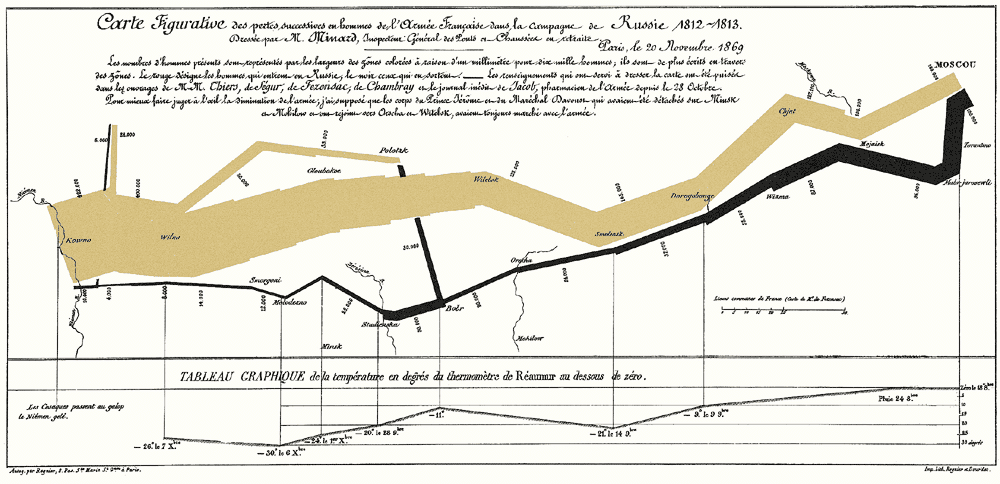
Thinking a lot lately about multimodal literacies and how many times I've seen interesting people (like Edward Tufte's "Naploleon's March" featured above) combine data and narrative. The work of Tim Harrower in the '90s first brought my attention to infographics, but the form has been around a lot longer.
Ryan Greenberg shared his chart of Films by Ratings with me. In many ways it's easier to see the concept rather than reading it through traditional text story.
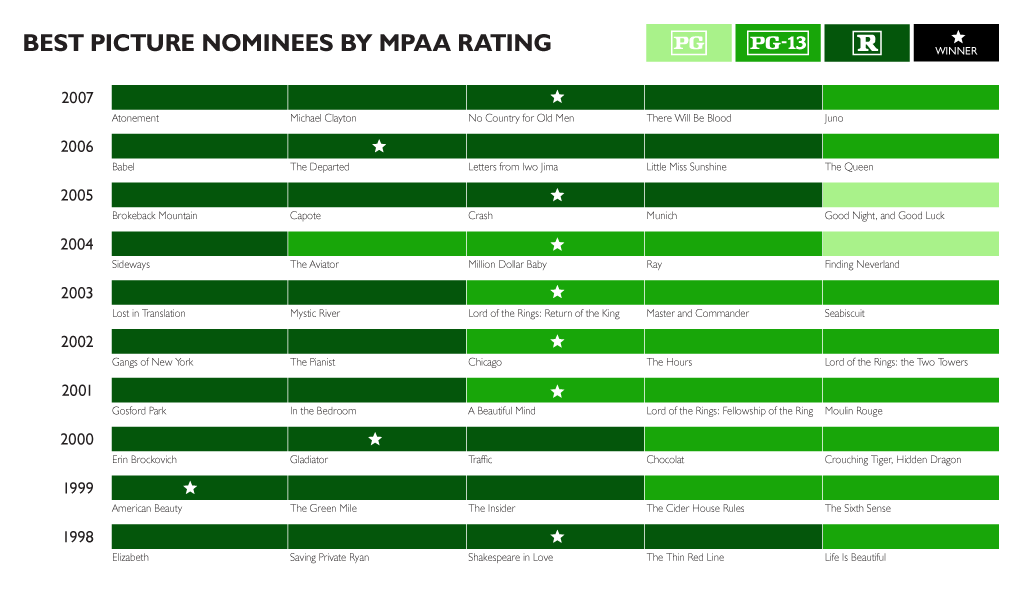
Then I came across Swivel who's mission is to "make data useful," and it helps me to see how information and images can be combined effectively. It seems like it's getting easier and more necessary to interpret information visually. And I'm thinking a lot about how I can bring this into my teaching.
Friday, October 10, 2008
print and online writing
 I've been talking with my high school newspaper staff lately about the difference between print and online writing. We're doing a good job of the monthly newspaper and putting out weekly video shows and the occasional podcast. Jakob Nielson of AlertBox says more eloquently what I'd like my students to consider:
Print publications — from newspaper articles to marketing brochures — contain linear content that's often consumed in a more relaxed setting and manner than the solution-hunting behavior that characterizes most high-value Web use. In print, you can spice up linear narrative with anecdotes and individual examples that support a storytelling approach to exposition. On the Web, such content often feels like filler; it slows down users and stands in the way of their getting to the point.
Web content must be brief and get to the point quickly, because users are likely to be on a specific mission. In many cases, they've pulled up the page through search. Web users want actionable content; they don't want to fritter away their time on (otherwise enjoyable) stories that are tangential to their current goals.
So I was intrigued by an editorial in my local newspaper earlier this week by a University of Utah communication professor about the future of newspapers. In the op-ed piece Kimberly Mangun spends the first half of the article discussing how groups like Nomad News are revolutionizing the way we gather and disseminate news, and the next part of the article outlining cutbacks in local newspapers. So by the end, I was a little surprised by her enthusiasm for the future of the print newspaper in its current form:
Newspapers, in one format or another, have been published in the United States for more than 300 years. They have weathered censorship, newsprint shortages, union battles, mergers and competition from "new media" - magazines, radio and television. But papers may be facing their biggest challenge yet: a triple whammy of rising newsprint costs, plunging advertising revenue and online journalism.
21st century journalism: The best of times and the worst of times - Salt Lake Tribune
Her conclusion? "Like the phoenix rising from the ashes, newspapers will emerge stronger and better than ever. But journalists and readers alike will need to take a collective deep breath and ride out the storm." With all due respect to the author (and to the print editor who chose to publish it), there's scant evidence in the piece to support her claim.
A lot of what is happening in information dissemination now is analogous to the rise of the wire services in the late 19th century– only now it's happening at the individual level. In effect, the feeds we construct in our news aggregators are our wire service. The only difference is that we don't have trustworthy, professional editors filtering content. That leaves us with the conundrum of information overload ... Enter the newsmaster.
... you and I are under a tsunami of information coming at us. It increases day by day and shows no signs of stopping. The number of interesting sources and blogs we like to follow increases daily and so the time required then to separate what is relevant to us from what is not. The newsmaster plays a vital role in this information economy. It saves you from having to go out and check all of the relevant news sources that publish news that may interest you. SHe acts as a filter
Monday, September 29, 2008
GTA reflection

On September 24 I attended the Google Teacher Academy in Chicago. The agenda speaks to the scope of the experience. Of course there were a lot of things that were noteworthy, but here are some things that stand out now that I've reflected on the event.
As a teacher who still incorporates both digital tools and traditional language arts tools (like books, pens, and paper), I was intrigued by the search function of the Books project. For example, suppose I can't quite locate a quote from the book, 1984, by George Orwell; I remember that there was a part where the character Syme is predicting the imminent demise of books, but I can't find the quote when I need it. I do a quick book search, and within seconds I've got it:

Whoever thought up the idea for the Books project has definitely done Orwell proud.... There are a lot of noble digital endeavors devoted to the book these days, like Project Gutenberg and Shelfari to name a couple, but as of this writing no one does book search better than Google.
Another area of interest is Google Forms, which I've only been using for a little while. I'd like to know how other teachers are using them. Certainly Thomas Barrett is someone who's doing some amazing things with that application now.
Suggestions for future GTA's? I could have spent a lot more time learning about advanced searches, and also how I can turn better manage the wealth (glut?) of information that can appear in my Reader on a daily basis.
Monday, September 15, 2008
Sunday, September 14, 2008
The Drill Bit
Although the "Drill, Baby, Drill" mantra first burst on to the scene on September 3 at the Republican National Convention, it seems to be gaining force lately. Wired Science is even sponsoring a "Drill, Baby, Drill" remix contest.
On September 8, I surveyed my 70 of my freshmen and AP English students about some of the election-year issues using Google Forms. When asked "Should the United States drill for oil in protected offshore waters?" 65% said no, 30% said yes, while 5% were undecided. It should be interesting to see if their opinions change as both sides try to steer the energy debate and my students research the issue.
On September 8, I surveyed my 70 of my freshmen and AP English students about some of the election-year issues using Google Forms. When asked "Should the United States drill for oil in protected offshore waters?" 65% said no, 30% said yes, while 5% were undecided. It should be interesting to see if their opinions change as both sides try to steer the energy debate and my students research the issue.
Tuesday, September 02, 2008
My dad in World War II, part two
My dad ships out for Australia in the summer of 1943. Gen. Douglas MacArthur pays his unit a visit.
Wednesday, August 27, 2008
My dad in World War II, part one
My dad talks about his enlistment, basic training, and how he went from horse buyer to the First Cavalry in WWII.
Saturday, August 23, 2008
Watch your language
When I first became aware of the Typo Eradication Advancement League, it warmed this English teacher's heart. Now it seems that even the war on inexact language is getting dangerous.
I'm not prudish about a lot of the errors I see, but sometimes I get a kick out of the many typos that jump out at me. Here's a photo from a realtor's listing in Red Lodge, Montana.
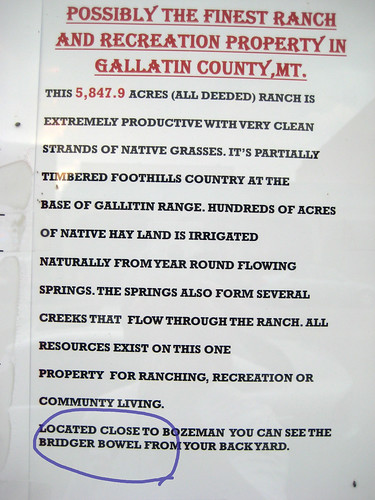
It may be the finest ranch in the county, but I'm not sure I'd like that view.
WAVY-TV reported that the brains behind the operation -- Jeff Deck of Somerville, Massachusetts, and his cohort Benjamin Herson of Virginia Beach -- admitted to their conspiracy and complicity to deface a historic marker because it contained a typographical error. Restitution and probation were ordered, and in addition the dynamic duo of grammarians with a purpose is banned for one year from national parks.
Typo Eradication Advancement League Stamped Out? - Associated Content
It may be the finest ranch in the county, but I'm not sure I'd like that view.
Saturday, August 16, 2008
Stevie Nicks went to my school?

The world came to know Nicks as the whirling songstress whose dramatic lyrics about a Welsh witch named "Rhiannon" helped bring her to the eye of the hurricane that became Fleetwood Mac in the 1970s. Her Utah friends say that her icon status and stage antics can be directly traced to the one month she spent studying at Salt Lake City's Judge Memorial Catholic High School. For the record, Nicks attended eighth and ninth grades at Wasatch Junior High before a bad math grade prompted her parents to send her to Judge. "Because she had gone to a private school, we would get together after school and talk about our different classes," said Karen Thornhill, who remembers Nicks when she went by Stephanie Lynn Nicks and twirled the baton at junior-high football games. "I distinctly remember her waving these capes around, imitating the nuns who taught her classes."
Wednesday, August 06, 2008
Peace in the goodness of time
 Tonight was one of those nights when being a teacher is so rewarding.
Ross Chambless, a former student of mine, has put together an impressive traveling exhibit called "Ceremonies, A Tale of Sister Cities: Matsumoto and Salt Lake." Ross just finished teaching English in Japan for four years in Matsumoto, Salt Lake's sister city. In his spare time he did some work for NPR and started collecting oral histories from the citizens of Matsumoto, which is detailed on his Ceremonies Exhibit blog. Those histories became the basis of the traveling exhibit done in conjunction with the Center for Documentary Arts that's at the Salt Lake City downtown library until August 8. (Photo courtesy of Ross Chambless, http://tinyurl.com/55omyd)
August 6 is the anniversary of the atom bomb being dropped on Hiroshima. Takashi Hiraoka, mayor of Hiroshima from 1991-1999 addressed a rapt audience at a commemoration at the Salt Lake library this evening. I'm reading John Hersey's Hiroshima with my seniors and now see the event from yet another perspective. And as Mr. Hiraoka spoke, I thought of Roy Okamoto, a former custodian at our school, who lost everything when he was sent to the internment camps in Topaz, Utah. We've come a long way in our relations with the Japanese people. As I later listened to the Amarume Japanese boys and girls choir, I couldn't help thinking of another international peace project that I've been involved with for years, The Ulster Project.

As I finished my conversation with Ross, I was filled with hope about our world. Ross feels like the Sister Cities program helped diminish stereotypes Utahns had about Japanese people; and I feel like things are improving in Northern Ireland because of programs like the Ulster Project. Here's hoping more educational exchanges like these continue.
Finally, a lasting impression from the evening was the legacy of Dwight D. Eisenhower, who I've come to respect even more after I watched Why We Fight. He started the Sister Cities International Program, and his granddaughter, Mary Jean Eisenhower, incidentally is following in his footsteps as president of People to People International. I now think of Eisenhower as one of our greatest presidents. A seasoned military man, here was the tone of his last days in the Oval Office.
Before he left office in January 1961, for his farm in Gettysburg, he urged the necessity of maintaining an adequate military strength, but cautioned that vast, long-continued military expenditures could breed potential dangers to our way of life. He concluded with a prayer for peace "in the goodness of time."
Wednesday, July 09, 2008
Visualizing presentations
I'm trying to pay more attention to design these days, both in my personal life and in my teaching/learning.

And when it comes to information designa recent infographic from XPLANE does a nice job of graphically representing the complex idea of how Obama has reinvented campaign finance by leveraging the power of online social networks. And this post by Ewan McIntosh is one of the best explanations of what makes for a good presentation.
Another quote I like: "PowerPoint doesn't kill presentations, bullet points do."
And when it comes to information designa recent infographic from XPLANE does a nice job of graphically representing the complex idea of how Obama has reinvented campaign finance by leveraging the power of online social networks. And this post by Ewan McIntosh is one of the best explanations of what makes for a good presentation.
When we experience a presentation we experience it in two ways - through the auditory nerves (ears) and the optical nerves (eyes). The brain is geared up to seeing above all else: 30% of the cortex is devoted to visual processing, only 8% for touch and 3% for hearing. So, biology tells us that our presentations must be, above all, visual.
Another quote I like: "PowerPoint doesn't kill presentations, bullet points do."
Wednesday, June 25, 2008
Is the Internet making us stupid?
In the latest issue of the Atlantic, Nicholas Carr writes a thought-provoking piece about how the Internet may be changing the very way we think.
As a teacher who incorporates a number of Web 2.0 tools, the article gives me pause. Since I also taught a couple of decades without the Internet in my classroom, however, some of what he writes seems a bit too simplistic. My classes start with 10-15 minutes of sustained reading (of books) or writing (in journals); there is a collective calm that ensues as the students and I engage in what one of Carr's sources might call "rich mental connections" with traditional texts and tools. Sometimes that involves writing on paper what we've been learning from online sources.

To use Carr's own metaphor, isn't it possible to be a person who enjoys both jet skiing and scuba diving? Just because I now jet ski, does that mean I can no longer scuba dive? That's silly. What this all means to me as an educator is that I've got to be more explicit in my teaching about the "rules" that govern reading and writing in traditional vs. digital composition. We don't need to unplug (as he seems to imply), rather we need to become fluent in the various media.
As the media theorist Marshall McLuhan pointed out in the 1960s, media are not just passive channels of information. They supply the stuff of thought, but they also shape the process of thought. And what the Net seems to be doing is chipping away my capacity for concentration and contemplation. My mind now expects to take in information the way the Net distributes it: in a swiftly moving stream of particles. Once I was a scuba diver in the sea of words. Now I zip along the surface like a guy on a Jet Ski.
To use Carr's own metaphor, isn't it possible to be a person who enjoys both jet skiing and scuba diving? Just because I now jet ski, does that mean I can no longer scuba dive? That's silly. What this all means to me as an educator is that I've got to be more explicit in my teaching about the "rules" that govern reading and writing in traditional vs. digital composition. We don't need to unplug (as he seems to imply), rather we need to become fluent in the various media.
Tuesday, June 17, 2008
ScribeFire tests
I'm always on the lookout for the easiest way to publish online, especially in my classroom. I've been using Flock because of the web snippet/clipboard capability. Now that Firefox has added the ScribeFire extension, I've been testing it.
I can't get the "Add an image" button to integrate with my Picasa gallery very easily.

I had to drag and drop the embed code into the source editing panel; when I pasted the code of this picture I took into the "Add an Image" popup window, I just got an unattractive little box like this one
It doesn't automatically format text that I pull from a source like Flock does, I had to manually make a block quote:
And I could only get out of the block quote formatting by going to the source editing tab, not from the rich editing tab that most users would prefer using. Maybe I'm missing something, but ScribeFire needs a lot of work if I'm going to bring it into my classroom (or into my own online publishing habits).
I can't get the "Add an image" button to integrate with my Picasa gallery very easily.
I had to drag and drop the embed code into the source editing panel; when I pasted the code of this picture I took into the "Add an Image" popup window, I just got an unattractive little box like this one
It doesn't automatically format text that I pull from a source like Flock does, I had to manually make a block quote:
you can drag and drop formatted text from pages you are browsing, take notes, and post to your blog.
And I could only get out of the block quote formatting by going to the source editing tab, not from the rich editing tab that most users would prefer using. Maybe I'm missing something, but ScribeFire needs a lot of work if I'm going to bring it into my classroom (or into my own online publishing habits).
Wednesday, May 28, 2008
Online offerings
The administration at my school is thinking about the future of our online offerings. I came across this today.
Obviously online course content delivery is coming soon, but "half" of all courses by 2019? Part of me says that's actually low. I think more than half will be offered a lot sooner.
Enrollment in online classes last year reached the 1 million mark, growing 22 times the level seen in 2000, according to the North American Council for Online Learning. That's just the start, says a new paper by the Hoover Institute, a conservative think tank at Stanford University. Its authors predict that by 2019 half of courses in Grades 9 to 12 will be delivered online. The efficiency of online learning accounts for this growth. But there's little research assessing the quality of these programs, which some experts say don't have enough official oversight.
Virtual schools see strong growth, calls for more oversight | csmonitor.com
Obviously online course content delivery is coming soon, but "half" of all courses by 2019? Part of me says that's actually low. I think more than half will be offered a lot sooner.
Tuesday, May 27, 2008
Living Archives
I've been following the development of the Living Archives Project because it's an authentic way to teach writing and because for years my students have been doing some local ethnography as well. The blend of traditional and Web 2.0 tools that Dave Cormier and the rest of the people on Price Edward Island are using is impressive. So as teachers start to wind down this school year and begin to think about the next academic year, this is an inspirational place to start.
View Larger Map
View Larger Map
Sunday, March 30, 2008
Earth Hour and Climate Savers

Did you miss yesterday's Earth Hour?
On Saturday, March 29, 2008, Earth Hour invites people around the world to turn off their lights for one hour – from 8:00pm to 9:00pm in their local time zone.
Climate Savers, mentioned in the Google news release, is advocating some painless, attainable ways to save energy.
The fight against global warming starts with you! Did you know that the average PC wastes nearly half the energy it consumes?
Saturday, March 29, 2008
Story crisis
Steve Jobs talks about a "story crisis," which should be refreshing for all writers. Sometimes we come across a really well written story and never think about the roadblocks that the story tellers encountered and what they did to overcome the 'crisis.' It's about being honest with yourself and listening to your heart.
"At Pixar when we were making Toy Story, there came a time when we were forced to admit that the story wasn't great. It just wasn't great. We stopped production for five months.... We paid them all to twiddle their thumbs while the team perfected the story into what became Toy Story. And if they hadn't had the courage to stop, there would have never been a Toy Story the way it is, and there probably would have never been a Pixar. "We called that the 'story crisis,' and we never expected to have another one. But you know what? There's been one on every film ... there always seems to come a moment where it's just not working, and it's so easy to fool yourself - to convince yourself that it is when you know in your heart that it isn't.
Steve Jobs speaks out - On dealing with roadblocks (10) - FORTUNE
Tuesday, March 11, 2008
More Brit kids prefer reading over TV
 The Independent reports that fewer British 11-year-olds prefer watching TV over reading. A telling sentence in the story:
The report, published to coincide with World Book Day, concludes there can be "cautious optimism" over the survey's findings and says that government encouragement of more flexibility and creativity in the curriculum could have helped foster more of a love of reading.Children turn off the TV and open a book instead - Education News, Education - Independent.co.uk
It would be interesting to see how the attitude of American children toward reading has changed over the same time period. Are we fostering a love of reading as a society?
Photo by Judge photog

Wednesday, March 05, 2008
Smart students
I came across this article about how smart Finnish teenagers are, based on a test adminstered by the OECD. Of course the causes are complex, but a couple of ideas struck me.
Another key idea comes out when a Finn student discusses her foreign exchange experience in an American school: "The rare essay question, she says, allowed very little space in which to write." The article doesn't oversimplify the differences in the two nation's education system, but I still couldn't help but notice that a curriculum that fosters reading and writing produces successful results.
Finnish teenagers are among the smartest in the world. They earned some of the top scores by 15-year-old students who were tested in 57 countries. American teens finished among the world's C students even as U.S. educators piled on more homework, standards and rules.
What Makes Finnish Kids So Smart? - WSJ.com
The article interested me for a number of reasons, one of which is the fact that the English Department at my school is currently having discussions about what students should read next year. This part of the article speaks volumes about the Finnish students' success:Finnish teachers pick books and customize lessons as they shape students to national standards. "In most countries, education feels like a car factory. In Finland, the teachers are the entrepreneurs," says Mr. Schleicher, of the Paris-based OECD, which began the international student test in 2000. One explanation for the Finns' success is their love of reading.
What Makes Finnish Kids So Smart? - WSJ.com
Another key idea comes out when a Finn student discusses her foreign exchange experience in an American school: "The rare essay question, she says, allowed very little space in which to write." The article doesn't oversimplify the differences in the two nation's education system, but I still couldn't help but notice that a curriculum that fosters reading and writing produces successful results.
Sunday, February 24, 2008
Aritstotle and authenticity

A lot of the teachers I’ve been listening to lately have been distraught over plagiarism in their students’ writing. I try to sympathize, but I can’t relate. I’m not having those issues. When writing begins with inquiry, makes connections to the self’s place in the world, and sourcing is transparent, there doesn’t seem to be much of a problem.
At the same time I’ve been reading about Aristotle’s rhetorical triangle – the connections and interdependence of speaker, audience, subject; the appeals to logos, ethos, pathos; and the added elements of context and purpose. When we compose from that framework, plagiarism is an awfully alien concept.
Painting by Raffaello Sanzio from Wikimedia Commons and is a public domain image

Thursday, February 14, 2008
Heart candy & literacy
Has anyone else noticed that heart candy just ain't what it used to be. While I was crunching on my Necco Sweathearts that my valentine gave to me this morning, I was a little puzzled by some of the messages on the candy, so I just had to snap a couple of photos as evidence. Since when is "and" an appropriate message to put on a candy heart?

And what does this say, "Lap Dog"? Does Necco need more proofreaders?

At any rate, one of my enduring memories of Valentine's Day present and past is opening up a box from my valentine and seeing a candy like the one below.

And what does this say, "Lap Dog"? Does Necco need more proofreaders?
At any rate, one of my enduring memories of Valentine's Day present and past is opening up a box from my valentine and seeing a candy like the one below.
Monday, January 21, 2008
Seeing Through

This last week my students wrote an essay taking a position on whether television has had a positive effect on presidential elections. I came across this post by Roy Peter Clark from the Poynter Institute that speaks to this well. In it he cites Edward R. Murrow, Aldous Huxley, and Thomas Jefferson among others. It's amazing how timely these thoughts are as we are bombarded with stories about image and our current presidential candidates:
Here's Murrow: "A society of the wise does not need television. Democracy, I suggest, cannot do its work well without it. Supposing that freedom is more important than safety, then the tyranny of the wise is only less objectionable than the tyranny of the unwise. The choice we face is between a despotism of the ruthlessly ambitious, not of the wise, and of an intelligent democracy." In other words, citizens need to develop a form of critical literacy that allows them to encounter the political words and images on the television screen and not just see them, but see through them.
Poynter Online - Writing Tools
It's not television, per se, that's the problem. It's what we do with it ... or rather what we don't do with it, that we won't often take the time to be critical consumers. That's the same for technology in general. I'm trying not to be skeptical, but it looks as if tomorrow's Frontline (Growing Up Online) might be another doom and gloom look at new media tools. Hopefully there will be a range of opinions.As in so many things, education is the answer.
Original image from "Wikimedia Commons" of Edward R. Murrow
Thursday, January 03, 2008
Good Educational Blogging
Here's my take on what educational blogging can be, with examples from youthvoices.net
Monday, December 31, 2007
Bigger and Better?
Although there are some obvious exceptions, bigger doesn't always mean better.
The more I work with computers in the classroom and incorporate technology in my own life, the more I get concerned about my own consumption habits but also about our consumption as a society. Consider the trend toward bigger TV's:
After watching cars get bulkier up to the gas shortages and oil embargo of the 1970's, and then witnessing our collective amnesia as we again bought larger and larger personal vehicles, culminating in the tank-like Hummer, I'm concerned with the proliferation of computers that require more energy. As a teacher I'm pretty sure that there will be more computers in classrooms next year than there were last year. And I don't see that trend changing. But what are institutions and businesses doing about this increase in comsumption. Is there much talk of conservation where you work?
Kudos to Tufts University in the late-1990's for at least trying to address the issue as an institution:
Tufts has made it a point to raise awareness of their institutional energy consumption. There should be more of that happening, even from an economic standpoint, let alone an enviornmental one.
So one thing on my list of New Year's resolutions is to become more aware on a personal level about Energy Star ratings and the data behind them, on a professional level as a classroom teacher to think more about when and how to best use the computers available (and when to shut them off), and to raise awareness of my school's consumption habits as a whole.
The more I work with computers in the classroom and incorporate technology in my own life, the more I get concerned about my own consumption habits but also about our consumption as a society. Consider the trend toward bigger TV's:
According the National Research Defense Council as told to The Christian Science Monitor, by 2009, when half of all new TV sales are expected to be extended- or high-definition digital sets with big screens, TV energy use will reach about 70 billion kilowatt-hours per year nationwide—about 50 percent higher than at present.
Big TV = Big Electric Bill : Robin Raskin : Yahoo! Tech
After watching cars get bulkier up to the gas shortages and oil embargo of the 1970's, and then witnessing our collective amnesia as we again bought larger and larger personal vehicles, culminating in the tank-like Hummer, I'm concerned with the proliferation of computers that require more energy. As a teacher I'm pretty sure that there will be more computers in classrooms next year than there were last year. And I don't see that trend changing. But what are institutions and businesses doing about this increase in comsumption. Is there much talk of conservation where you work?
Kudos to Tufts University in the late-1990's for at least trying to address the issue as an institution:
The average desktop computer uses about 120 Watts (the monitor uses 75 Watts, and the CPU uses 45 Watts.) Laptops use considerably less, around 30 Watts total. 4,300 Tufts-owned computers X 0.12 kW X 250 workdays X 8 hours = The university uses 1,032,000 kWh per year to run all of Tufts computers just during business hours.
This amounts to: 1,032,000 kWh X 11 cents = $113,500 per year in electricity costs. Greenhouse gas emissions for this electricity amount to: 1,032,000 kWh X 1.45 lbs of CO2 per kWh / 2,000 = 748 tons of CO2 per year. 100,000 - 500,000 trees are needed to offset these yearly emissions of CO2! (A tree absorbs between 3-15 lbs of CO2 per year.)
Tufts has made it a point to raise awareness of their institutional energy consumption. There should be more of that happening, even from an economic standpoint, let alone an enviornmental one.
So one thing on my list of New Year's resolutions is to become more aware on a personal level about Energy Star ratings and the data behind them, on a professional level as a classroom teacher to think more about when and how to best use the computers available (and when to shut them off), and to raise awareness of my school's consumption habits as a whole.
Tuesday, November 13, 2007
NCTE 2007

I'm doing a session at the National Council of Teachers of English in New York City on Sunday, 11/18. Here's a link to the presentation slides. and another link to additional resources mentioned at the presentation.
Since 1911, NCTE has worked to advance teaching, research, and student achievement in English language arts at all scholastic levels.
Thursday, October 25, 2007
notebooks & blogs, part 1

I'm not in a one-to-one computer classroom, so my students don't always have access to Web 2.0 tools. This quarter I've had my students do both the traditional writer's notebook (pen on paper) and blogging when we can. As I have them write their reflections on the two different media, I'm interested in what kind of differences they see. My commentary can be heard by clicking "writer's notebook reflections" on the audio player on the lefthand side of this page or on my GCast channel. Photo by Rosalie Sloan.
Wednesday, October 10, 2007
learning something new every day
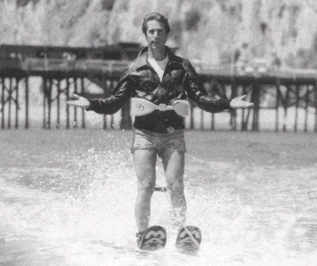
It is nice to see someone be willing to end their show before it jumps the shark and begins losing its fans.
I came across this on one of my student's posts today, so I asked him about it since I admit I've never heard the term "Jump the shark" before. This image and the accompanying article from Wikipedia enlightened me.
Evidently the phrase dates back to the '70s when The Fonz jumped a shark while waterskiing in an attempt to revive the show's ratings. Funny I'd never heard that before. I guess I would have been one of those viewers who had abandoned the show.
Saturday, September 29, 2007
one-to-one computing
I've been using laptops in my classroom at least once a week this year. I think they've been useful for the educational blogging we've been doing. But I came across this article about how one district in New York is getting rid of their laptops.
1. Whenever hardware is brought into the classroom without adequate training for the teachers, it flops.
Laptops work in my classroom because they allow students to read online (with Google Reader), conduct inquiry, and then comment on their reading in blog posts that are properly cited. That then initiates a conversation with others who might be interested in their inquiry.
For this type of learning, one-to-one computing isn't the best tool, it's the only tool.
“After seven years, there was literally no evidence it had any impact on student achievement — none,” said Mark Lawson, the school board president here in Liverpool, one of the first districts in New York State to experiment with putting technology directly into students’ hands. “The teachers were telling us when there’s a one-to-one relationship between the student and the laptop, the box gets in the way. It’s a distraction to the educational process.”
Seeing No Progress, Some Schools Drop Laptops - New York Times
It's always good to think about whether what we're doing in the classroom is actually helping our students learn. But upon closer examination, this reversal of the one-to-one computing trend may not be all that surprising. Here are a couple of reasons, (followed by excerpts from the same article cited above):1. Whenever hardware is brought into the classroom without adequate training for the teachers, it flops.
Such disappointments are the latest example of how technology is often embraced by philanthropists and political leaders as a quick fix, only to leave teachers flummoxed about how best to integrate the new gadgets into curriculums.2. Therefore, introducing the technology isn't going to increase standardized test scores, which unfortunately is the litmus test.
Yet school officials here and in several other places said laptops had been abused by students, did not fit into lesson plans, and showed little, if any, measurable effect on grades and test scores at a time of increased pressure to meet state standards.The pressures are real and there's a lot of money involved, so school communities should proceed with caution. Later in the article math teachers said that they prefer pencil & paper, and graphing calculators because those are more efficient tools. That makes perfect sense.
Laptops work in my classroom because they allow students to read online (with Google Reader), conduct inquiry, and then comment on their reading in blog posts that are properly cited. That then initiates a conversation with others who might be interested in their inquiry.
For this type of learning, one-to-one computing isn't the best tool, it's the only tool.
Tuesday, September 18, 2007
Social Networking in the classroom
Teachers can introduce social networking and educational blogging into the classroom, but will our students ever value it?
In my opinion, not only to social networks have a place in today's classroom, they're soon to become commonplace.
“They’re using social networking sites like crazy, but they don’t necessarily think those have a place in the classroom,” said Gail Salaway, one of the primary authors and a fellow at ECAR.It does give me pause. Part of me thinks it's a turf war of sorts. Some members of the milennial generation are possessive of their MySpace/Facebook territory. Once, when my students were talking about an adult's MySpace profile, some of them questioned whether adults had any place in that social network. So another part of me thinks that the thinking cited above comes from a limited view of social networking and its implications. Social networks already are proliferating in the adult world - by April 2007 there were already 10 million LinkedIn users.
In my opinion, not only to social networks have a place in today's classroom, they're soon to become commonplace.
Wednesday, September 05, 2007
Information Reputation
A lot of people have problems citing Wikipedia as a source for academic research. A UC Santa Cruz professor has developed software that flags questionable entries. The idea is that the source of the most reliable information on Wikipedia doesn't need to be edited. So if those trustworthy sources can be identified, then users would know if the information can be trusted:
I don't know if this software will stick, but I think the idea has implications for educational blogging. For instance in the future more news will be user generated, so the question will be whether our information is trustworthy. One litmus test will be our information reputation. If one blogger has a history of only making social posts on MySpace and another has a history of posts filled with associative links to reliable sources, who will you trust?
If you haven't already, it's time to start thinking about the information trail you're leaving behind.
"The idea is very simple," de Alfaro said. "If your contribution lasts, you gain reputation. If your contribution is reverted [to the previous version], your reputation falls."
I don't know if this software will stick, but I think the idea has implications for educational blogging. For instance in the future more news will be user generated, so the question will be whether our information is trustworthy. One litmus test will be our information reputation. If one blogger has a history of only making social posts on MySpace and another has a history of posts filled with associative links to reliable sources, who will you trust?
If you haven't already, it's time to start thinking about the information trail you're leaving behind.
Friday, August 31, 2007
What's a good educational blog post?
In my collaboration with the teachers on Youth Voices, we've found that students' posts were often more compelling when they "introduced, inserted, and interpreted" quotations from other sources, especially blogs and news sources that their students found by searching Google Blog Search and Google News.
Here are some examples from last semester of Youth Voices bloggers using published voices from blogs and news items in their own blog posts. As you read them think about the qualities that make a good educational blog post:
Here are some examples from last semester of Youth Voices bloggers using published voices from blogs and news items in their own blog posts. As you read them think about the qualities that make a good educational blog post:
- Paul students at East Side Community High School, NYC: Jennifer, Felix, John (podcast listener)
- Susan's students at Eleanor Roosevelt High School, NYC: Robyn, Mercedes, Christina
- Chris's students at Judge Memorial High School, Salt Lake City, Utah: Ameera, Eric's China post, Emerson's myspace
Thursday, August 30, 2007
blog prep
This week I introduced students to readers and exploring RSS. The teachers I collaborate with at YouthVoices have set up a wiki about using Google Reader in the classroom. The document gives the students a good start to getting relevant research. On the first day they got used to the reader, subscribed to some bundles, and began managing their subscriptions.
On the second day I showed how we can subscribe to various feeds from our local papers, the Salt Lake Tribune and the Deseret News. Both sites differed significantly, and what students soon see is that if they're going to subscribe to the information they want, they're going to have to learn to look for it.
And that's also true of navigating the different deep web databases. The information is there, and half the struggle is getting there.
Monday, August 27, 2007
spelunking the deep web

There's been a lively discussion for the past couple of weeks on Teachers Teaching Teachers on whether the locked databases that our public libraries have access to are worth the trouble. Paul Allison does a nice analysis of the results of his search:
For me, databases start with three strikes against them: * they aren't easy to access * sources from them can't be collected in an RSS reader (EBSCOhost seems to be an interesting exception, but how do you become a member of EBSCO?) * links to sources found in a database won't work for the general reader.
Weblogs & Wikis & Feeds, Oh My!
Those a three big drawbacks to using these "deep web" resources. Maybe I've been reading too much Orwell, but what if in the future all knowledge is owned, and the only way to locate it is to learn how to navigate the labyrinthine ways of these independent databases. Take public records for instance: if we're to be citizens in a participatory democracy, we've got to teach and learn ways to get to this information (and I don't think it's readily available via a Google search). Lifehacker has a post about finding public records online.You can use the web to find lots of things: information, videos, books, music, games, and yes, even public records. While our most private information can (usually) not be found online, you can track down items like birth certificates, marriage and divorce information, obituaries and licenses on the web. Keep reading to learn where to find public records online.
Technophilia: Where to find public records online - Lifehacker
I'm thinking that even though deep web resources can't be linked to, they can at least be excerpted from for now. And I'm also thinking that researching via RSS isn't enough, even though it may not be worth the effort.
Monday, August 06, 2007
Watch your (voucher) language!
If the choice of words is any indication, they may have a point. Voucher supporters, including many lawmakers, favor words that carry strong emotions in conservative Utah - such as "government schools," "unions" and "education bureaucracy" - when criticizing public schools and the board.
Salt Lake Tribune - As debate rages, Ed panel chief stands firm against private school vouchers
If the polls are any indication, however, vouchers in Utah are headed for defeat (45% of voters are "very likely" to vote against vouchers while only 12% are "very likely" to vote for them, according to a July 9 KSL-Deseret Morning News survey).
As an English teacher I'm particularly interested in the language employed. In UnSpun, Jackson & Jamieson do a good job of illustrating that whatever side "frames the issue, claims the issue." In my opinion the pro-voucher folks are doing a much better job on the language front than in the polls. Take the ballot language for instance. Those opposed to vouchers take nearly 250 words to make their point, and I think the first-time reader will have to slog through these facts:
- Reasonable Choices Are Available Utah already offers many good choices through "open enrollment" and charter schools. Taxpayers can't fund every choice.
- Proposed Voucher Laws are Inadequate Even with last-minute legislative "patch work," voucher laws authorize schools with too little oversight, no real coursework or attendance requirements, lax standards for teachers and minimal accountability to taxpayers. Risk of inadequate and unstable schools is high.
- Whom Would Vouchers Help? Probably not the disadvantaged. Even with vouchers, parents with a modest income couldn't afford to send their children to good private schools.
- Is There "Additional Money" For Public Schools? No. For five years, transferring students would be double funded by taxpayers - in the private schools and the public schools they left behind. Thereafter, public school funding would be cut to reflect lost enrollment.
- Would Vouchers Prevent Tax Increases? Unlikely. Subsidizing students now privately funded creates a projected deficit of almost a half billion dollars. These dollars would come from other worthy projects like health care, public safety and roads. If we have extra taxpayer money, it would be better spent reducing class sizes and improving Utah's public schools.
- "Bureaucrats and Liberals"? Who are they? Not the 29,000 dedicated, caring and underpaid teachers in our neighborhood schools; also not Utah's commonsense conservative citizens who oppose another entitlement program. The real "bureaucrats and liberals" are the subsidy advocates and out-of-state voucher pushers looking for Utah to save their faltering national movement. VOTE NO ON VOUCHERS
Yikes! I read that and feel like I've been flogged. Contrast it with the 75-word pro-voucher language penned by Rep. Steve Urquhart:
It's simple. A vote for vouchers is a vote to improve education. If you vote "Yes,"
- school funding will improve
- children's options and opportunities will increase
- academic achievement will go up
- parents will gain a stronger voice within the system.
All I can say is, Mr. Urquhart must have had an effecitve English teacher.
Sunday, August 05, 2007
What I did on my summer vacation, part 2
Here's a link to a short audio contemplation about rain and world peace.
And here's the view out the back of my sister's cabin later that morning. You can hear some sandhill cranes in the background.
And here's the view out the back of my sister's cabin later that morning. You can hear some sandhill cranes in the background.
Murals in Northern Ireland
I've been involved with the Ulster Project a peace program that brings together Northern Irish teens, for a number of years now. And though we'd like to believe things are getting better, that the Troubles are easing, this post from Liam Moore shows that positive change is happening, as can be seen in Belfast's graffiti.
If the trend that Moore describes continues, it brings up an interesting question for our group – one that resurfaced with the Good Friday agreement – namely, what if the Ulster Project isn't necessary any more? It's an interesting dilemma. If the Troubles go away, programs like the Ulster Project aren't needed anymore.
It seems strange to say, but that really would be good news!
Iconic soccer figures such as George Best and Samuel English now grace some of the walls too. Belfast residents now prefer looking up to a different kind of hero than the paramilitary fighters of the past. A new generation is emerging, growing up in less dangerous times
Web Urbanist » Beyond The Troubles: Murals of Belfast, Northern Ireland
If the trend that Moore describes continues, it brings up an interesting question for our group – one that resurfaced with the Good Friday agreement – namely, what if the Ulster Project isn't necessary any more? It's an interesting dilemma. If the Troubles go away, programs like the Ulster Project aren't needed anymore.
It seems strange to say, but that really would be good news!
Wednesday, August 01, 2007
Online research
More reasons to incorporate applications like Google Reader into our curriculum....
The Shorenstein Center on the Press, Politics, and Public Policy reports that although teens spend a lot of time online, they don't spend much of that time following the daily news closely.
The Shorenstein Center on the Press, Politics, and Public Policy reports that although teens spend a lot of time online, they don't spend much of that time following the daily news closely.
Teens get more news from cable news programs than from newspapers or even from the internet, according to the report, yet they watch these programs infrequently compared with older Americans. Teens spend a lot of time online, but not necessarily getting news. About a fifth of teens and young adults cited the internet as their main source for news. The report also suggests that teenagers prefer soft news over hard news, or feature stories to breaking coverage.
Tuesday, July 31, 2007
Blogging and researching inquiry
Paul Allison has been doing some thinking about how to use Google Reader in the classroom. There was a Teachers Teaching Teachers podcast about blogging and research this past May, and there's a podcast about RSS scheduled for edtechtalk for this week.
Last year I had success getting students oriented to and enthused about Google Reader; that's the easy part. But this year I'd like to have students use this tool even better, and that means having them research things that matter. Paul has started a wiki about orienting students to Reader more efficiently this year. I like how he frames the next step:
Last year I had success getting students oriented to and enthused about Google Reader; that's the easy part. But this year I'd like to have students use this tool even better, and that means having them research things that matter. Paul has started a wiki about orienting students to Reader more efficiently this year. I like how he frames the next step:
How can we organize this in a curriculum for students? What comes first? How do we do this while also helping students start with their own questions and experiences?
Elgg Plans » Using Google Reader
For me, there's a question I first have to ask myself: where does my own inquiry come from? The answer? My own inquiry comes from my identity. It's where these identities intersect that we find our inquiry. Here's a link to a Google Doc that explains my thinking on this. And here's a link to how this manifested itself on the "Using Google Reader" wiki.Monday, July 09, 2007
iShakespeare
I asked my seniors what medium made Shakespeare more understandable. Here's what they said.
Tuesday, July 03, 2007
Sunday, June 10, 2007
NCLB & authentic writing
The National Commission on Writing released Writing and School Reform a while ago outlining how authentic, personalized writing instruction can happen in today's standard-driven classrooms. If you haven't read it, it's worth reading now.
Friday, June 08, 2007
Ed Blogging Redux
Here's a link to a nice overview of educational blogging to date. I especially like its reference to a rationale for educational blogging and its links to top educational blogs.
Sunday, May 06, 2007
student work
Here's a link to some enhanced podcasts and videos that students did at Nancy Miller Day, an arts celebration day at Judge. Most of these students had never really used GarageBand for enhanced podcasts or shot much video, so what they did from start to finish in three hours shows what students can do with little time or guidance.
Wednesday, April 25, 2007
Nancy Miller Day 2004
Thursday, April 26 is Nancy Miller Day. Here's a link to an enhanced podcast of a previous Nancy Miller Day at Judge in 2004.
Friday, April 06, 2007
Wiki in the English class
Here's a short video about how I use wikispaces in my English classroom.
If you're not sure what a wiki is, here's a helpful resource.
If you're not sure what a wiki is, here's a helpful resource.
Friday, March 02, 2007
are they really different?
I hear a lot about how today's students are so much different than preceding generations. For instance, I heard David Warlick speak this morning at the UCET conference. Among other things he said that kids today are more competitive, risk-taking, sociable and self-confident than the preceding generation. I've heard him, Marc Prensky and others say similar things, but I'm not completely convinced.
They often cite examples of kids who multitask as evidence of the trend, replete with pictures of a teen plugged into an iPod and a laptop, chatting and playing video games all at the same time. These kids are bored with school because teachers no longer know how to hold their attention, they say. But then I think about how bored I was through much of high school, and how I multitasked by listening to a transistor radio with one earpiece, how I daydreamed, wrote song lyrics in notebooks that my teachers never saw, how kids passed notes (a precursor of "chatting"), and I wonder – are today's kids really that different than kids were back in the day? Have the students changed or are they just using different tools?
I'm no technophobe and I understand that we need to change much of how we teach, so don't get me wrong. I find myself agreeing with a lot of what's said by Warlick, Prensky, et al. I'm just looking for some proof (not anecdotal evidence) that the students I teach now are that much different than when I started twenty-some years ago. Can anyone cite any research?
Friday, February 23, 2007
Voltaire's voice
This quote by Voltaire is a fine metaphor for the writing voice (sent to me by Marilyn Olander).
"L'écriture est la peinture de la voix; plus elle est ressemblante, meilleure elle est."
"Writing is the painting of the voice; the closer the resemblance, the better it is."
- from Voltaire's "Orthography," in his Philosophical Dictionary
"L'écriture est la peinture de la voix; plus elle est ressemblante, meilleure elle est."
"Writing is the painting of the voice; the closer the resemblance, the better it is."
- from Voltaire's "Orthography," in his Philosophical Dictionary
Monday, February 19, 2007
finding your voice
I'm interested in how writers find their voice. Here's an excerpt from a Critique magazine interview with Peter Elbow that I just came across:
"I want to emphasize something enormously simple about voice that in a sense I've only figured out in the last few years. If there's one activity that I think is the most helpful thing about writing, apart from just writing and writing, it is reading your writing out loud and also reading the writing of others out loud. Saying the words in your voice, with your mouth: I think that's the most powerful way to help one’s writing and to help one’s voice."
— Peter Elbow
Sunday, February 18, 2007
dirty work
I just learned that teaching is the dirtiest job. The findings come from the Clorox Company. Here are some of the highlights:
Teachers’ phones, keyboards, and computer mice had the most germs.
Accountants' desks had the most germs of any desks sampled.
Lawyers had the least germy desks.
Publicists had the least germy phones.
Bankers had the least germy keyboards.
TV producers had the least germy computer mice.
"Surfaces regularly used by teachers, accountants, and bankers harbored nearly two to 20 times more bacteria per square inch when compared to other professions," the report states.
Sources: The Clorox Company, “Office Germs Research 2006 Results.” News release, The Clorox Company.
"Surfaces regularly used by teachers, accountants, and bankers harbored nearly two to 20 times more bacteria per square inch when compared to other professions," the report states.
Sources: The Clorox Company, “Office Germs Research 2006 Results.” News release, The Clorox Company.
Monday, February 05, 2007
educational blogging
A lot of teachers are using blogging in their classrooms now. Here's a link to a useful Educause article advocating educational blogging. It's a little dated, but still valid.
Then today I came across an article from the Jan. 30, 2007 issue of the Chronicle of Higher Education called Blog Overload. It's a good reminder not only about blogging, but about all writing. Good writing is purposeful and authentic.
Then today I came across an article from the Jan. 30, 2007 issue of the Chronicle of Higher Education called Blog Overload. It's a good reminder not only about blogging, but about all writing. Good writing is purposeful and authentic.
Thursday, January 18, 2007
AP audit
The folks at College Board are conducting an audit to make sure that's what being labeled as AP in high schools meets their criteria. Here's a link to a Google Doc of my AP English Language and Composition curriculum. Feel free to give me any input.
Friday, January 12, 2007
Google Apps in my classroom
A quick overview of some of the Google applications I've been using in my classroom this semester.
Friday, December 29, 2006
Dogboy dating video
Since Dogboy Goo is a good friend of mine, I told him I'd post his dating video for him.
Wednesday, November 15, 2006
Google's Student Speakout
We recently completed the Global Warming Student Speakout in my English classes. It makes me wonder about the differences between digital writing and traditional writing. Here are four things I've noticed:
- Revision is becoming more visible. It used to be a black box. Among other things this is significant for writing teachers (e.g. a writing conference with more evidence) as well as for the writer.
- Linkage. It feels different reading a document that can link to the source material rather than just cite it.
- Web surfing for information during collaborative projects is more conductive to the ebb and flow of conversation, and is better suited to the psychological connections our brains make.
- Audience matters. Nothing new here. Audience influenced the choices we make in traditional writing too. But a potential immediate worldwide audience that allows others to interact with the content? That seems different. Maybe Marshall McLuhan's predictions about a global tribe aren't so far off.
Wednesday, November 01, 2006
Google Docs in the classroom
Is anyone else working on Google's "Global Warming Student Speakout"? Here are some thoughts on the first couple of days with Google Docs in the classroom.
Friday, October 13, 2006
Sound and Story
Jenny Brundin, a radio journalist from KUER in Salt Lake City, Utah visited my classroom recently. Here's what she said about sound and story.
Sunday, September 17, 2006
confidence in voice
A great writer has a strong voice. "Voice" is one of the 6 Traits of Writing, but a lot of teachers don't see it as one of the more important traits.
On June 24, 2006 I saw Garrison Keillor perform an episode of Prairie Home Companion in Salt Lake City, and I again wondered about voice. How does a writer come by a strong voice -- where does that confidence come from? I remember the first time I heard my voice through the sound system of a big auditorium; it was unnerving. But now when I hear myself like that, it's not a big deal. Speaking from experience, I got better as a writer once I got used to my voice, and that included actually listening to my recorded voice, becoming accustomed to it, "hearing" my voice as I composed, and then making editorial decisions based this awareness of voice.
So when I had my classes write about their thoughts on 9/11 and played their recorded voice back to them, I asked them what they thought about their voice.
Do you think seniors in AP English would have more confidence in their voice than my 9th graders do? I did. But I was wrong. 63% of the seniors responded negatively (e.g. "I sound weird"), while 65% of the 9th graders felt the same (e.g. "I sound like a freak").
Do you think girls or boys have more confidence in their voice? Out of the five seniors who responded positively to the experience (e.g. "my voice sounds more professional, cool") 4 of them were boys. All six 9th graders who responded positively were boys.
I think that if I get them more accustomed to their voice, they'll be better writers. That's why I include podcasting in my curriulum.
Monday, September 11, 2006
Subscribe to:
Posts (Atom)